



Lecture Review: Martti Koskenniemi, Academician of the Finnish Academy of Sciences – "The Law of International Society: Reflections on the Concept of 'Social' in International Law"
Date:2025-05-12
On April 18, 2025, the "Globalization and Comparative Law Lecture Series" of Peking University Law School (PKULS), themed "The Law of International Society: Reflections on the Concept of 'Social' in International Law", was successfully held in Room B102 of Koguan Building. Co-hosted by the Institute of International Law of PKU, the Peking University WTO Law Research Center, and the Institute of Area Studies of PKU, the lecture was delivered by Prof. Martti Koskenniemi, Academician of the Finnish Academy of Sciences and Emeritus Professor of the University of Helsinki. Prof. Zhao Hong of PKULS and Former Chair of the WTO Appellate Body, Prof. Antony Carty (Visiting Scholar at PKULS), Prof. David Kennedy of Harvard Law School, A.P. Chen Yifeng of PKULS, Dr. Kong Yuan (Associate Researcher of the Institute of European Studies, Chinese Academy of Social Sciences), Dr. Liu Yang of Renmin University of China Law School, Dr. Xie Kankan of PKU School of Foreign Languages, Dr. Lai Huaxia of PKU School of International Relations, Dr. Chen Xiaohang of PKULS, Lecturer Cao Wenjiao of China Foreign Affairs University, Postdoctoral Fellow Lin Zhaoran of PKULS/Institute of Marine Studies, and Postdoctoral Fellow Huang Pengbei of China University of Political Science and Law (CUPL) served as discussants. The lecture was hosted by A.P. Zhang Yongle, Vice Dean of the Institute of Area Studies of PKU and PKULS. More than 100 teachers and students attended the lecture, which received enthusiastic responses.
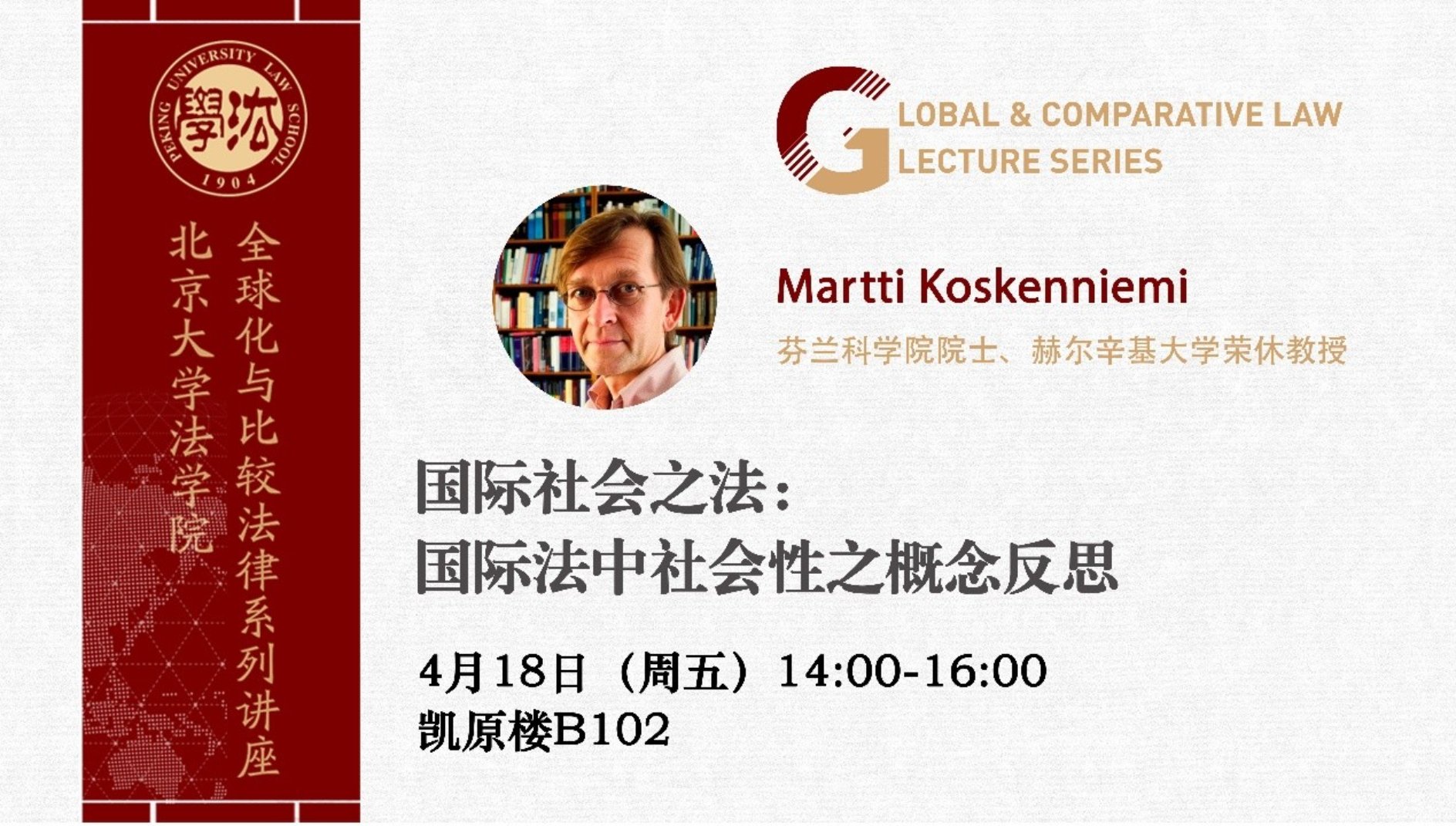
The lecture focused on the concept of "international society" and its evolutionary context and influence in international law. Prof. Koskenniemi pointed out that although the concept of "international society" is frequently used in international law, it still lacks a clear definition. Therefore, researching this concept can analyze the international law concepts it carries. He argued that international law as a discipline originated from the German public law tradition: from von Martens' attempt to construct "external public law" to the emergence of the dual opposition between "state" and "society" in the 1820s and 1830s. Hegel keenly observed this change and proposed the concept of civil society. German jurist von Stein extended the concept of civil society to the global level, creating the concept of "Gesellschaft" (society). However, liberal and conservative scholars in Germany held different views on whether society and politics could be objects of social science research: the former believed "society" could provide a new research object (e.g., von Mohl proposed establishing a new "international sociology"), while the latter argued society was merely a reflection of state power (e.g., von Treitschke, Bluntschli).
The establishment of the Institut de Droit International in 1873 marked the starting point of the professionalization of modern international law. However, the institute used the concept of "civilization" rather than "society" at its founding, holding that "international law is the legal conscience of the civilized world". Prof. Koskenniemi emphasized that "civilization" is a vertical, hierarchical concept, while "society" is a horizontal, equalizing one. He highlighted the importance of Jellinek in the development of international law: Jellinek distinguished between social science (describing what is) and legal science (addressing what ought to be). At the end of the 19th century, international law could have developed into a social, both descriptive and normative, reality-based and scientific doctrine. However, due to the "is-ought" distinction introduced by scholars like Jellinek, international law lost the opportunity to become a comprehensive science. Economics and sociology constructed their own normative and descriptive models on this basis, while the analytical framework of modern international law became narrower. British international lawyer Oppenheim was a representative of this trend, arguing that international law was what remained after economics and sociology had carved out their domains, essentially norms governing relations between Christian civilized states organized around the idea of the "international family" – a Eurocentric worldview based on Christian values. World War I shattered the order imagination of the Christian international family. In the early 20th century, many scholars attempted to use international law to construct an international order beyond the Christian state community, with some advocating for the sociology of international law, focusing on the underlying interests shaping legal relations.
In the early 20th century, international relations emerged as a discipline, reflecting on and even criticizing the legalist tradition. E. H. Carr sharply criticized legalism, especially the view that states could form an international society based on interest coordination. In the 1970s, Hedley Bull sought to rebuild the international relations discipline around the concept of international society – an anarchic society based on state interests rather than kinship or hegemony. Hermann Mosler argued that international society could be seen as a legal community, whose ideology would become the universal conviction for states to abide by international law. Additionally, Julius Stone and others discussed the relationship between international law and sociology, while Wolfgang Friedmann believed law was a tool of social order, closely linked to social structures. In the 1980s, an increasingly market-defined concept of society emerged, with the state conceived as a promoter of privatization. From the 1990s to the early 21st century, social movements such as environmental protection movements emerged, which also reshaped the concept of the state.
In the discussion session, Prof. Antony Carty put forward different views on the origin of international law and the importance of struggles in the contemporary world. Prof. Zhao Hong explored the possibility of forming a better social structure and shared values at the international level and China's potential contributions. Dr. Liu Yang further reflected on the subject and role of constructing the concept of society. Dr. Kong Yuan discussed the legalization process of concepts such as "a community with a shared future for mankind". Dr. Xie Kankan supplemented the focus on colonialism, arguing that the civilizing mission narrative and international law may mutually reinforce and reshape each other to a certain extent. Lecturer Cao Wenjiao noted that the social concept in positivism may be a relic of the early natural law tradition. Dr. Lai Huaxia explored whether the concept of international society would undergo further transformation under the "great changes unseen in a century". A.P. Chen Yifeng analyzed whether the turn of international law to the concept of society might be an attempt to preserve the theoretical space of international law studies. Prof. David Kennedy evaluated the sociological, structuralist, and historical research methods involved in the lecture from a methodological perspective. Prof. Koskenniemi responded to the questions and views of all discussants and answered questions from the students present.
At the end of the lecture, A.P. Zhang Yongle made a summary. He thanked the participating teachers and students and expressed expectations for continuing similar academic discussions in the future to promote the development of interdisciplinary research in international law.
Translated by:Han Kaibo
Edited by: Lu Zhixuan