



Global Chair Lecture No. 93 | Henk Vording on the Allocation of Taxing Rights in the Digital Economy
Date:2025-06-25
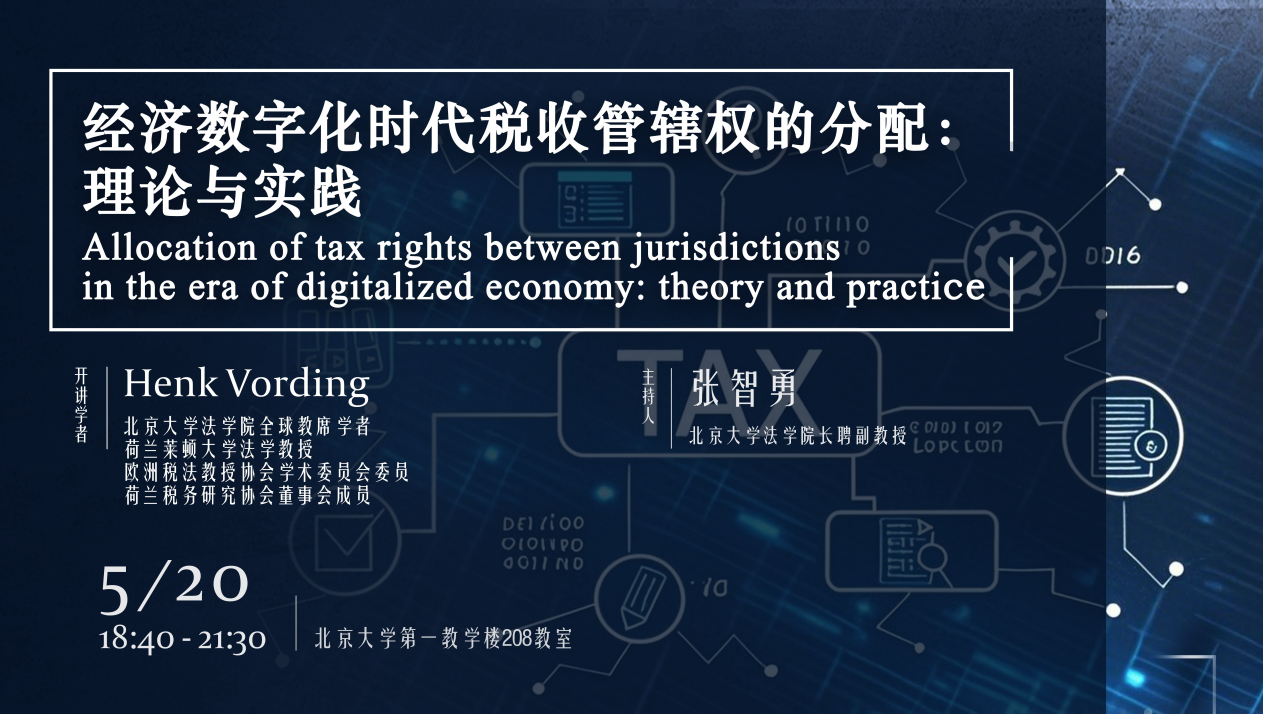
On May 20, 2025, Professor Henk Vording, Global Chair Professor at Peking University Law School and Professor at Leiden University Law School, delivered a lecture entitled “The Allocation of Taxing Rights in the Digital Economy: Theory and Practice” at Peking University Law School. The lecture was hosted as part of the Global Chair Lecture Series and moderated by Zhang Zhiyong, Tenured Associate Professor at Peking University Law School.
Drawing on the historical development of international tax rules, Professor Vording reviewed the traditional framework governing the allocation of taxing rights between residence and source jurisdictions, including permanent establishment rules, transfer pricing principles, and methods for eliminating double taxation. He noted that while these rules were originally designed to prevent double taxation, they have proven insufficient in addressing challenges such as base erosion and profit shifting, particularly in the context of digitalization and the growing importance of intangible assets.
The lecture then examined recent international tax reforms, with a focus on the OECD’s BEPS Project and the subsequent BEPS 2.0 “Two-Pillar Solution.” Professor Vording introduced the core objectives and institutional logic of Pillar One, which reallocates a portion of multinational enterprises’ residual profits to market jurisdictions, and Pillar Two, which seeks to establish a global minimum tax through mechanisms such as the GloBE rules and domestic minimum top-up taxes.
Professor Vording also discussed the current state of implementation of the Two-Pillar Solution, highlighting differences in approaches among major economies and the potential implications for developed and developing countries. He concluded by noting that while Pillar Two has made substantial progress at the domestic legislative level in many jurisdictions, the future trajectory of global tax reform remains subject to political coordination and international consensus.
Translated by: Ma Zihan
Edited by: Shi Xiaoyu