



Lecture Review: The Complex Relationship between EU Law and the Laws of Its 27 Member States — A Civil Law Perspective
Date:2025-03-27
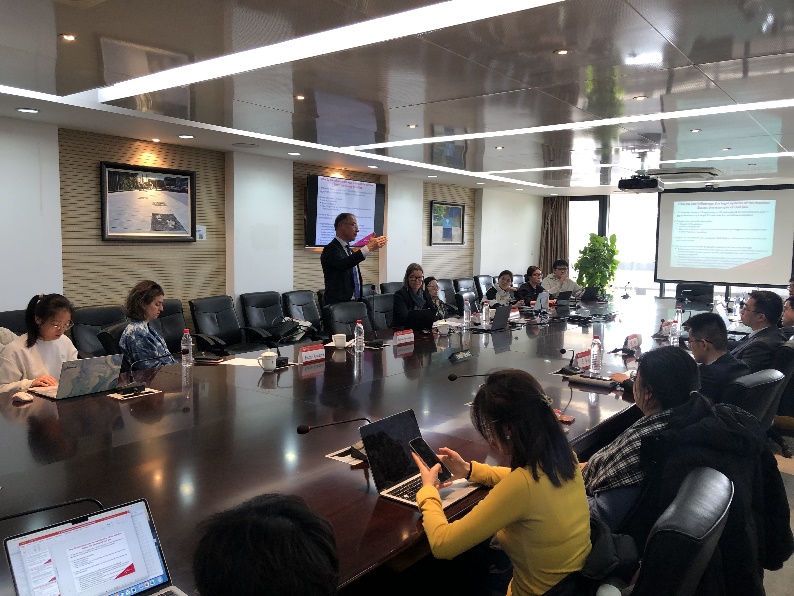
On March 17, 2025, Prof. Harriët Natalie Schelhaas, Dean, and Prof. Fabian Amtenbrink, Vice Dean of Erasmus School of Law (ESL), Erasmus University Rotterdam, visited Peking University Law School (PKULS) and delivered a lecture titled “The Complex Relationship between EU Law and the Laws of Its 27 Member States — A Civil Law Perspective.” The event was moderated by Prof. Dai Xin, Vice Dean of PKULS, and attracted over 50 faculty members and students.
Prof. Schelhaas and Amtenbrink began by outlining the dual legal order of the European Union. They emphasized that EU law—derived primarily from the Treaties—operates alongside national legal systems but enjoys primacy: where EU and national rules conflict, EU law prevails. Moreover, certain EU legal acts have direct effect, meaning individuals can invoke them before national courts even without domestic implementing legislation.
They distinguished between two main forms of secondary EU legislation: regulations, which are directly applicable in all member states without further action, and directives, which set binding objectives but leave member states discretion in how to transpose them into national law. This distinction shapes how harmonization is achieved across diverse legal traditions.
Prof. Schelhaas then focused on the impact of EU law on civil law domains. She highlighted extensive harmonization in areas such as consumer protection, contract law, and tort law—largely driven by directives aimed at ensuring a level playing field in the internal market. She noted that national courts play a crucial role in enforcing these rights, often required to interpret domestic law in conformity with EU standards or adjust procedural rules to ensure effective remedies.
During the Q&A session, Prof. Xue Jun, Dai Xin, and Wang Huawei engaged with the speakers on topics including digital consumer rights, legal instruments for protecting weaker parties in commercial transactions, and the EU’s consensus-building process in contentious policy areas.
Translated by: Yin Shuaitong
Edited by: Yin Dongyong