



Among the World’s Top 16: Peking University Achieves Another Outstanding Result at the 67th Jessup International Law Moot Court Competition
Date:2026-04-08
From March 28 to April 4, 2026, the 67th Philip C. Jessup International Law Moot Court Competition was held in Washington, D.C., United States. This year’s competition attracted 806 teams from nearly 100 jurisdictions worldwide, the largest number of participating teams in its history. After intense competition, the Peking University team, composed primarily of faculty members and students from the Law School, distinguished itself as the only Chinese team to reach the global round of 16, ranking first among all participating teams from China, including Hong Kong, Macao, and Taiwan. For their outstanding performances, Lü Yizhou and Yu Xiaohan were recognized among the world’s top 50 and top 100 oralists, respectively.
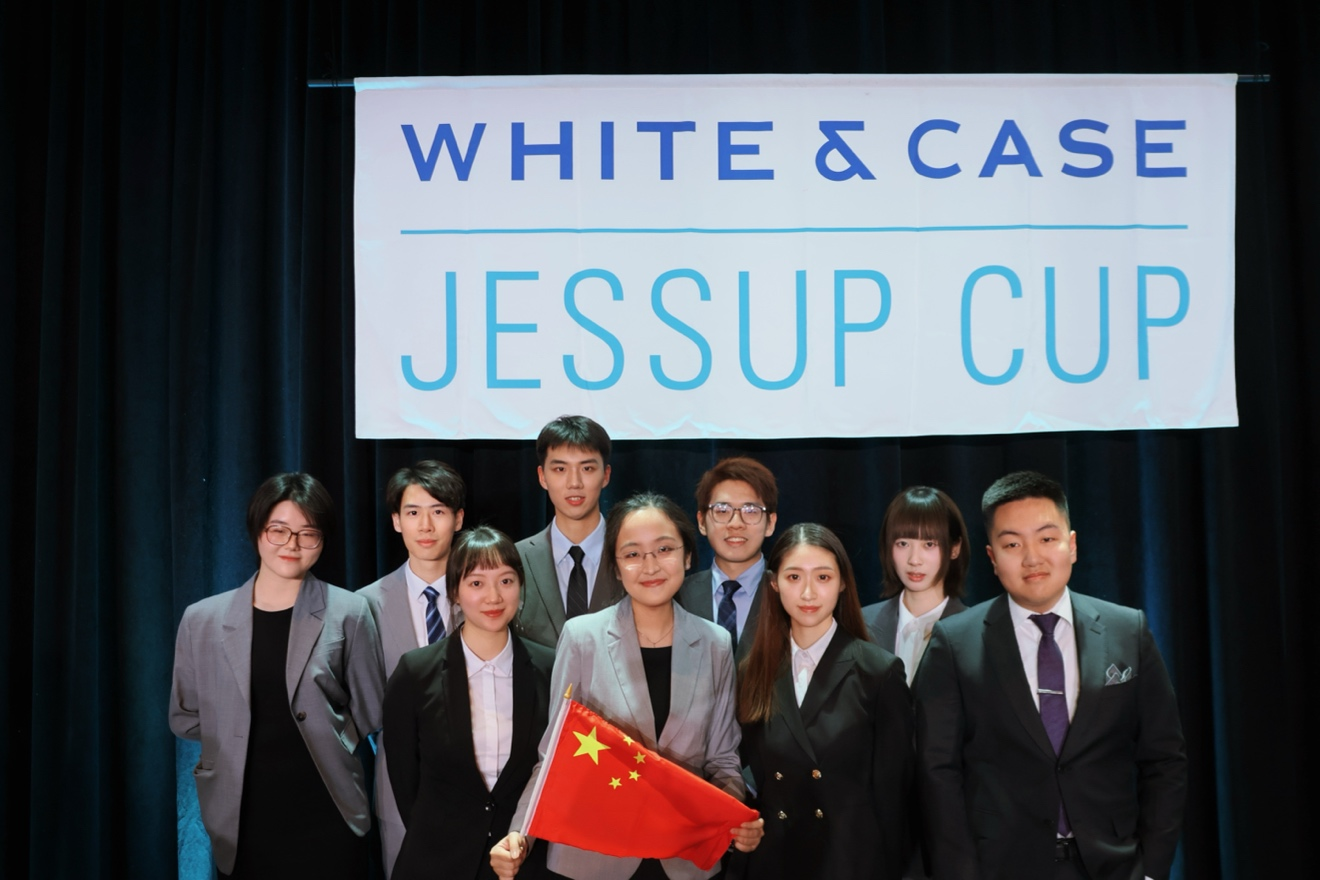
The Peking University team
The Jessup International Law Moot Court Competition consists of national and international rounds. Teams must qualify through the national rounds to advance to the International Rounds in Washington, D.C. A total of 67 teams competed in the 2026 China National Rounds. Peking University advanced through successive rounds and claimed the national championship with a commanding 10–0 victory in the final. Among the 164 teams that qualified for the 2026 International Rounds, Peking University won all four preliminary matches, ranking sixth worldwide and advancing directly to the round of 32. This marked the team’s best-ever preliminary-round performance at the International Rounds, surpassing its previous record of seventh place in 2023. It was the third time that Peking University had reached the global round of 16 in the nearly four decades since it became the first Chinese team to participate in the International Rounds in 1989. It was also only the fourth time that a Chinese team had reached this stage in the competition’s 67-year history. Peking University remains the only Chinese team to have reached the global round of 16 since the elimination rounds were expanded to include 55 teams.
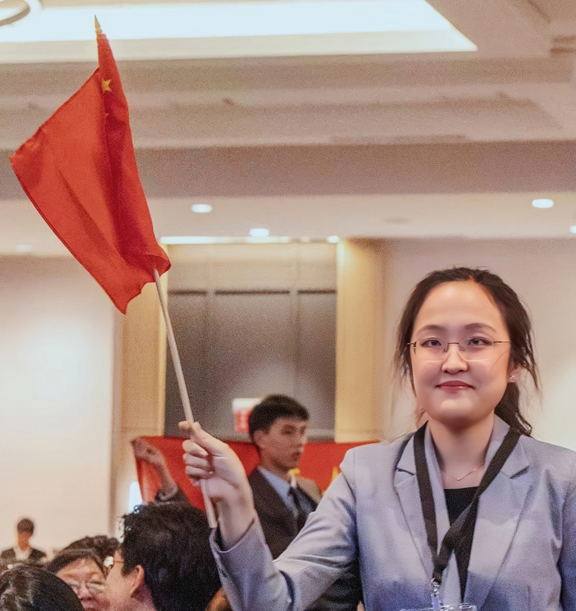
As the national champion, the Peking University team was entitled to carry the national flag at the opening ceremony of the International Rounds
This year’s Peking University team was supervised by Assistant Professor Liao Xuexia of the Law School. Huang Yuanheng, a doctoral student from the 2025 cohort, and Wang Yuan and Zhang Xinnuo, undergraduate students from the 2022 cohort, all from the Law School, served as student coaches. The oralists were Lü Yizhou, a Law School undergraduate from the 2022 cohort, and Yu Xiaohan, a Yuanpei College undergraduate from the 2023 cohort specializing in law. The researchers were Xie Zhengjie, a Law School undergraduate from the 2023 cohort; Li Yanran and Tan Jialin, Law School master’s students from the 2025 and 2024 cohorts, respectively; and Lin Jiaqi, a School of Economics undergraduate from the 2023 cohort.
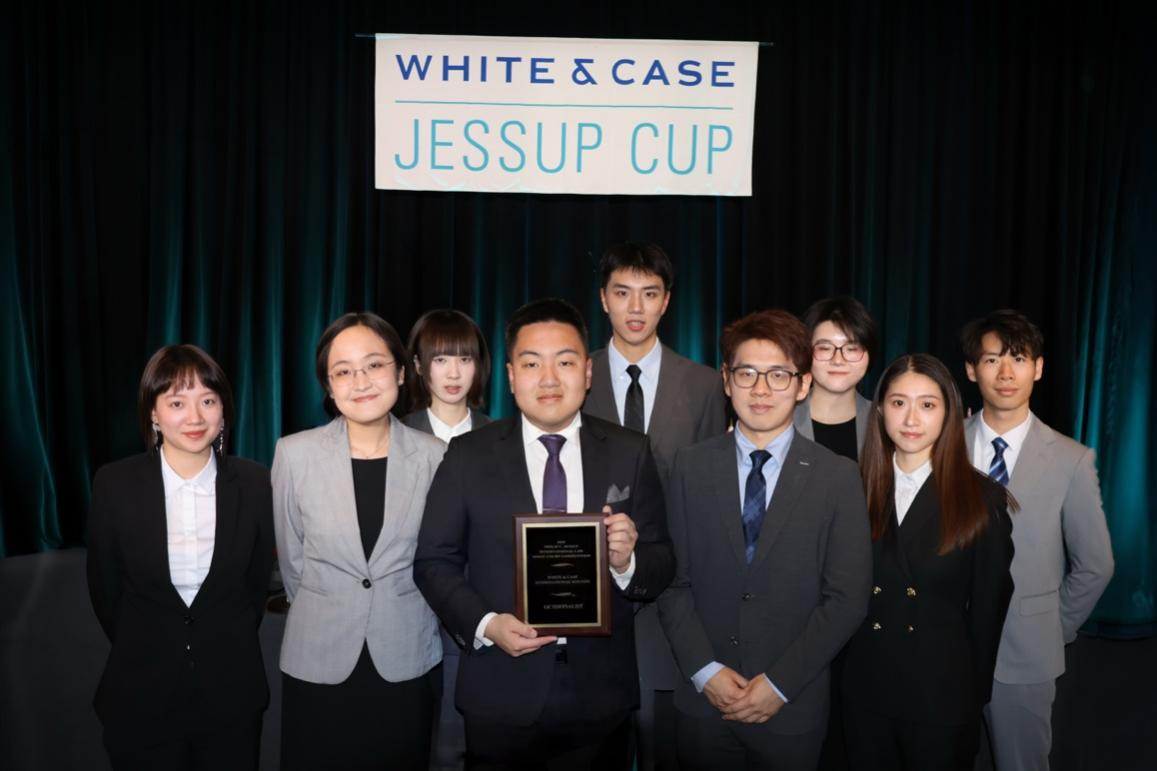
The Peking University team at the awards ceremony
Since the team was formed in July 2025, all members had promptly begun preparing for the competition, dedicating themselves to legal research with intense focus and enthusiasm. With guidance from their faculty supervisor and student coaches, they consulted a wide range of Chinese- and English-language literature on the competition problem, conducted extensive case research and legal analysis, and held regular discussions and focused training sessions, gradually compiling detailed research materials totaling tens of thousands of words. After winning the national championship, the team remained grounded and continued daily oral argument practice, repeatedly reviewing its performance and refining its arguments to deepen its understanding of the problem. During the competition, team members drew on their solid legal knowledge, strong logical reasoning, and excellent oral advocacy skills to respond confidently to probing questions from judges across different jurisdictions, securing successive victories. In the elimination rounds, they remained composed when facing native English-speaking teams from different countries, rising to the challenge and overcoming formidable opponents to demonstrate the abilities and distinction of Peking University’s aspiring legal professionals.
During the team’s preparations, faculty members, students, and alumni, including Liu Xiao, Chen Jing, Li Mengyi, Lei Qi, Rao Haoyu, Sun Yixian, Sun Xiaohan, Chen Haiwen, Jiang Wanghao, Liu Xingzhi, Lu Yujin, Shan Weitong, Su Dongyu, Zhao Xingyi, Zheng Huiwen, Chen Bozheng, Xue Zeyu, Jiang Yuxin, Hu Yanqin, Zhang Zhuoran, Qian Yuxiao, Sun Sihuang, Huang Jiawen, Zhang Shiyi, Zhou Zhongchen, Luca Viscapi, Liu Rong, and Zhang Yang, offered valuable advice and guidance. Clifford Chance provided important support for the team’s preparations, while the Law School’s Youth League Committee provided strong organizational support.
Established in 1960 and organized by the International Law Students Association (ILSA), the Jessup International Law Moot Court Competition is a specialized legal advocacy competition that aims to nurture international law talent and promote exchanges of scholarship and practical experience in international law across countries. As the world’s largest and oldest moot court competition, it is widely known as the “Olympics” of international law. Since the China National Rounds were first held in 2003, Peking University had won six national championships—in 2006, 2012, 2015, 2016, 2018, and 2023—and finished as the world runner-up in 2023, achieving the best result ever recorded by a Chinese team in the competition.
Peking University’s seventh national championship and advancement to the global round of 16 in 2026 demonstrate the depth of Peking University Law School’s experience and strength in training legal professionals for foreign-related legal affairs. Through systematic theoretical courses in international law, comparative law, and the laws of individual countries, alongside practical teaching through moot court training and internships at international organizations, the School has long sought to develop students’ ability to apply abstract rules to real cross-border disputes. Drawing on its strong academic foundations, the School promotes interdisciplinary programs connecting law with economics, international relations, and area studies. These programs guide students in understanding the political, economic, social, and cultural reasoning underlying different legal systems and in developing the core competencies to address, and even take the lead in resolving, complex international issues. Looking ahead, the School will continue to use leading international moot court competitions as a platform to build a system of two-way internationalization that brings together resources, develops innovative approaches, and strengthens connections within China and internationally. It will help shape the discourse on training legal professionals for foreign-related legal affairs and contribute to educating Chinese legal professionals who can shape rules through legal dialogue between China and the wider world, safeguard rights and interests amid globalization, and contribute their insights to addressing humanity’s shared challenges.