



International Week Review || International Academic Paper Workshop: Institutional Impact of Technological Evolution
Date:2025-11-26
On November 6, 2025, the "International Academic Paper Workshop: Institutional Implications of Technological Evolution", part of the 2025 International Week series hosted by Peking University Law School and Institute for Digital Rule of Law, Peking University, was successfully held. Emanuel Towfigh, Prof. of Law and Economics at EBS Business School; Elisabeth Paar, Lecturer at the University of Graz; Gilad Abiri, A. P. of Law at Peking University School of Transnational Law; and Michael Veale, Prof. of Technology Law and Policy at the Faculty of Laws, University College London, delivered presentations and critiqued their latest research in Room 307 of the Koguan Building at Peking University Law School. Assistant Professor Bian Renjun, Tenured A. P. Zuo Yilu, and A. P. Hu Ling from Peking University Law School provided commentary on these studies. The event was chaired by Dai Xin, Vice Dean and Tenured A. P. of Peking University Law School. Over fifty faculty members and students from both within and outside the university attended, generating enthusiastic responses.
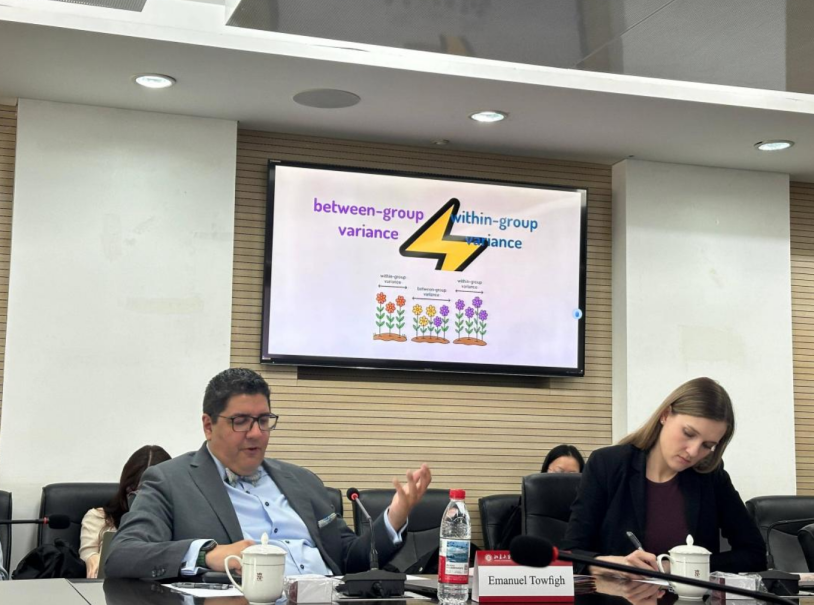
At first, Emanuel Towfigh delivered a report titled "Rethinking Equality: From Legal Intuition to Empirical Verification". He proposed a framework aimed at revolutionizing equality rights theory, which introduces statistical methods into legal dogmatics to address the structural flaws of existing equality principles. He pointed out that the courts lacks objective, verifiable criteria when determining discriminatory acts within the current legal system. To resolve this challenge, integrating statistics reveals a core standard: legal distinctions are preliminarily justified only when inter-group differences in the crowd are greater than that in the intra-group. This theory does not aim to replace judicial rulings or abolish group classifications. Rather, it seeks to provide judges with rational tools grounded in empirical data (such as variance analysis). Simultaneously, this theory strives to avoid stereotypical understandings of specific group identities, making legal criteria for human distinctions more transparent.
Bian Renjun, Gilad Abiri, Elisabeth Paar, and Dai Xin commented on the report. Emanuel Towfigh noted in the discussion that the immediate purpose of this research is to limit judges' reliance on pure intuition in adjudication. By eliminating irrational criteria, it promotes judicial rationalization and prevents the proliferation of identity politics.
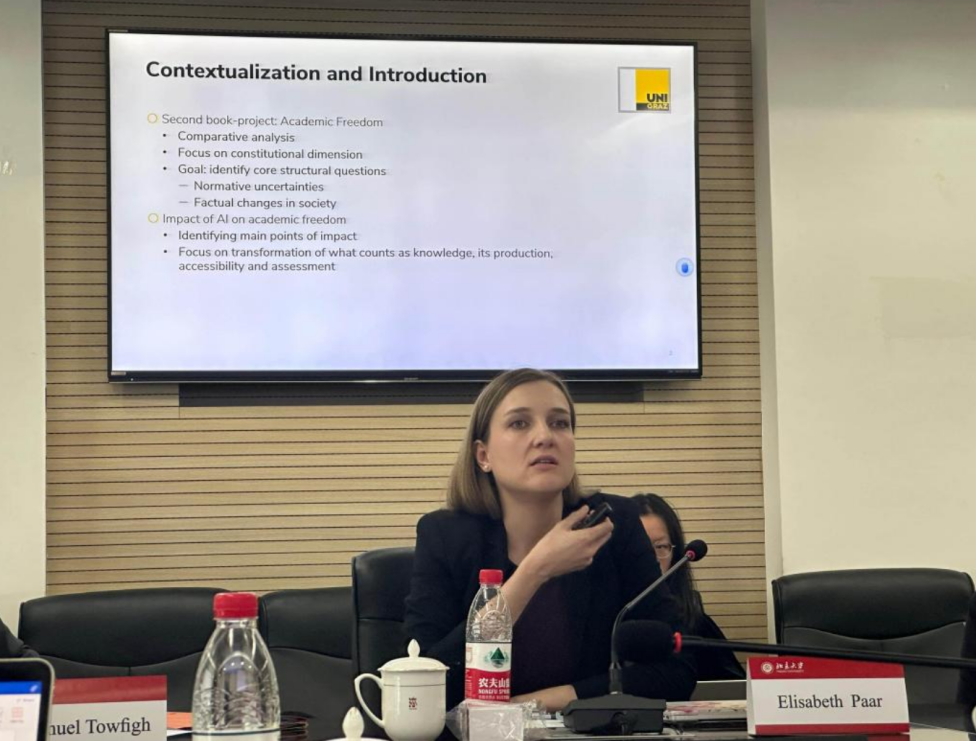
Then, Elisabeth Paar delivered a report titled "AI and Academic Freedom". Taking AI as a starting point, she explored its impact on academic freedom and whether traditional legal and normative frameworks for protecting academic freedom remain effective. The challenges AI poses to academic freedom can be summarized in three aspects. First, at the level of expert knowledge production, AI's black-box nature affects knowledge credibility, and it is questionable whether AI can generate new knowledge by academic methodologies. Second, at the level of expert knowledge acquisition, AI leads to dependency on AI providers for research information, potentially undermining the cultivation of critical thinking in the next generation. Third, at the level of expert knowledge evaluation, the involvement of AI in academic writing and peer review blurs judgments on the authenticity of scholarly work, while existing rules on AI usage declarations prove limited in effectiveness. At a deeper level, AI may also impact the value of truth and our understanding of it, and academia is more vulnerable than commonly imagined.
Zuo Yilu, Michael Veale, Emanuel Towfigh and Gilad Abiri made comments. Elisabeth Paar pointed out in the discussion that knowledge production is both a hallmark of academic freedom and its reward, and academic freedom does not exist solely for the purpose of cultivating democratic capacity.

Gilad Abiri then delivered a report titled "Mutually Assured Deregulation". He critiqued the prevailing concept of "Regulation Sacrifice" in current global AI policies. In his view, the three pillars underpinning this concept are untenable. The first is the assumption of lasting advantage, which posits that temporary speed advantages can translate into long-term technological leadership. However, AI spreads rapidly, and factors such as model open-sourcing, improvements in algorithm efficiency, and talent mobility prevent any technological edge from being sustained. The second is the innovation drag hypothesis, which claims that regulation significantly hinders the pace of innovation. Yet, well-designed regulatory frameworks can actually foster innovation and investment by providing clear rules and reducing uncertainty. The third is the enhanced security hypothesis, which suggests that relaxing regulations to win the race strengthens national security. In reality, deregulation undermines national security across all time horizons.
Hu Ling, Zuo Yilu, Emanuel Towfigh, and Michael Veale made comments. During the discussion, Gilad Abiri mentioned that in China, the relationship between the government and platforms is largely government-led, whereas in the United States, large tech firms sometimes “take over” the government. This difference may lead to differing approaches between the two countries in responding to the regulatory demands of large tech firms.
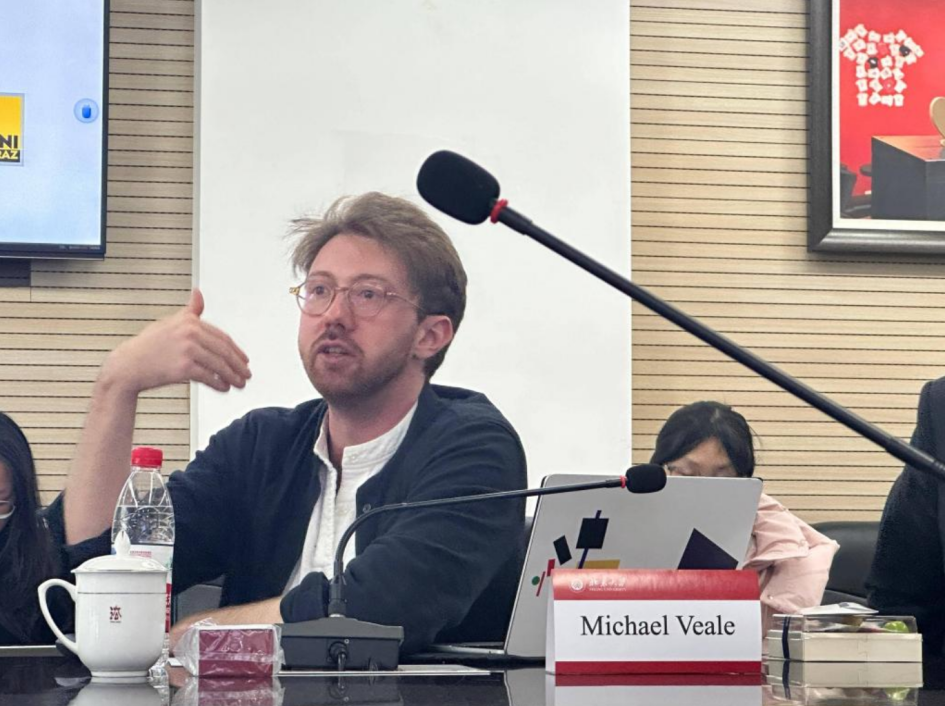
Finally, Michael Veale delivered a report titled "Some Commonly-Held but Shaky Assumptions about Data, Privacy and Power". He believes that academia currently holds four unreliable assumptions about data. First, the assumption that data protection equates to privacy. Second, the assumption that data possesses perfect non-rivalry. Third, the assumption that the scale of a data set is more important than experimental capability. Fourth, the assumption that large platforms derive their competitive advantage from data accumulation. We should adopt a more mature and nuanced approach to understanding power in the digital age—one grounded in a deep understanding of technological infrastructure and practices, rather than focusing solely on data itself.
Dai Xin, Emanuel Towfigh and Elisabeth Paar made comments. During the discussion, Michael Veale expressed his agreement with the redefinition of the non-competitive concept. He believes that the key point is the process of data usage and its deep integration with infrastructure.
Translated by: Zeng Linyu
Edited by: Zhang Wenyi