



International Symposium on Emissions Trading Systems Co-hosted by Peking University and Yale University Successfully Held
Date:2025-03-27
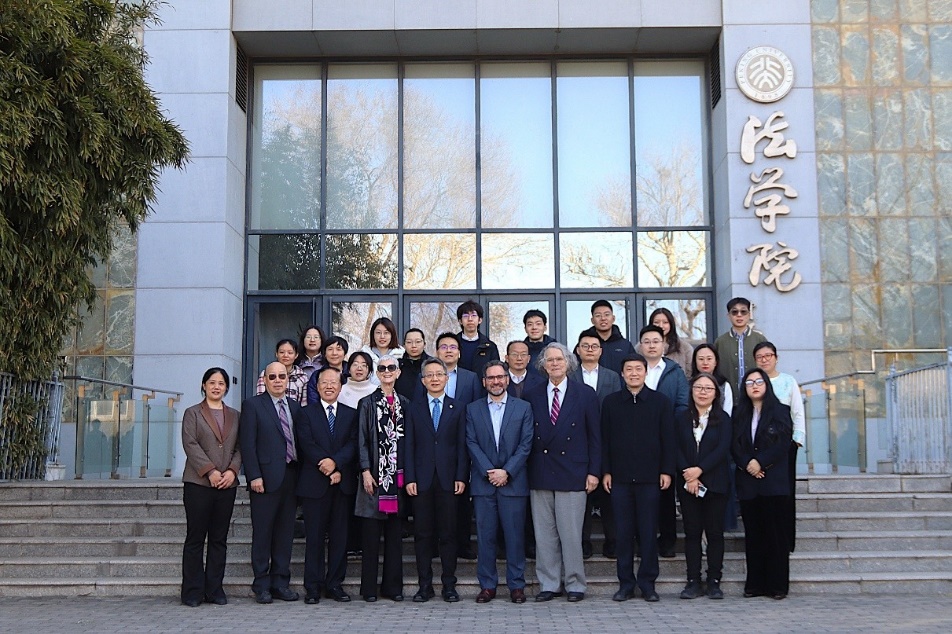
On March 19, 2025, the “2025 International Symposium on Emissions Trading Systems” was held at the Leo Koguan Building, Peking University Law School (PKULS). The event was hosted by PKULS and co-organized by Yale Law School’s Paul Tsai China Center.
I. Opening Ceremony
The opening session was moderated by Prof. Jin Zining, Researcher at PKULS. Dean Guo Li of PKULS delivered the opening remarks, welcoming all participants and highlighting the symposium’s role in fostering academic dialogue and global cooperation on climate challenges. He also congratulated Dr. Jin on the simultaneous release of her research report on the U.S. Regional Greenhouse Gas Initiative (RGGI) in both Chinese and English.
Jamie Horsley, Senior Research Scholar and former Executive Director of the Paul Tsai China Center, introduced the U.S. delegation and emphasized the importance of mutual learning to advance emissions trading systems in both countries.
Bie Tao, Chief Legal Counsel of the Ministry of Ecology and Environment, underscored the significance of discussing the legal frameworks and practical innovations of carbon markets amid evolving global climate governance.
II. Morning Session: Global Experiences and Lessons
Chaired by Prof. Jin Zining, this session featured keynote speeches by four experts. Prof. Donald Elliott (Yale Law School) shared insights from designing the U.S. Acid Rain Program and reflected on American experiences. Bie Tao outlined China’s legislative progress and practice in emissions trading. Prof. Alex Wang (UCLA School of Law) discussed California’s cap-and-trade program and its implications for China. Prof. Deng Haifeng (Tsinghua University) analyzed the operational mechanisms and effectiveness of China’s carbon market. He highlighted the differences between China’s administrative-led model and the U.S. market model based on the Coase Theorem, evaluating the practical effectiveness of China's approach.
In the subsequent roundtable, practitioners including Wang Lingxin (Deputy General Manager, China Carbon Emissions Registration & Clearing Co., Ltd.) and Fan Dongxing (Deputy Director, National Carbon Market Operations Center, Shanghai Environment and Energy Exchange) joined scholars to discuss allowance allocation, legal disputes, and the relationship between carbon trading and carbon taxes.
III. Afternoon Session: Public and Private Law Dimensions
Chaired by Ms. Jamie Horsley, this session featured five speakers. Prof. Cao Mingde (China University of Political Science and Law) addressed legal challenges in China’s carbon market and proposed legislative recommendations. Dr. Robert Klee (Yale School of the Environment) reviewed lessons from the RGGI program. He highlighted its unique approach of investing auction proceeds into consumer benefit programs and complementary clean energy policies. Prof. Jin Zining presented her RGGI report , RGGI Carbon Emission Trading System Research Report. She explained her comparative research methodology and shared key lessons from RGGI relevant to China’s Interim Regulations. Assistant Professor Wu Kaijie (PKULS) examined China’s MRV (Measurement, Reporting, and Verification) system. He analyzed typical cases of data fabrication and the legal obligations of technical service providers. Associate Prof. Zeng Yingying (Zhongnan University of Economics and Law) explored the localization and globalization of carbon trading rules, comparing China’s legal characteristics with those of the EU and the U.S. The closing roundtable focused on foundational legal issues, including the legal nature of carbon allowances, legislative models, and third-party liabilities.
IV. Closing Ceremony
The symposium concluded at 5:30 p.m., with closing remarks by Professor Wang Jin of PKULS. Ms. Horsley and Dr. Jin expressed their gratitude to all participants. During the symposium, Prof. Jin’s bilingual report, RGGI Carbon Emission Trading System Research Report, was officially launched. The event facilitated in-depth exchanges between Chinese and U.S. experts, providing valuable academic and policy insights for advancing the rule of law in carbon markets.
Translated by: Yin Shuaitong
Edited by: Yin Dongyong