



Samuel Moyn: The Historical Turn in International Law and Its Contemporary Implications
Date:2025-06-23
On June 1, 2024, the Institute of International Law at Peking University successfully hosted the lecture “The Historical Turn in International Law and Its Contemporary Implications.” The event featured Samuel Moyn, Professor of Law and History at Yale University and Dean of the Grace Hopper School at Yale University, as the keynote speaker.
The lecture was chaired by Chen Yifeng, Tenured Associate Professor at Peking University Law School. Panel discussions featured Zhang Kangle and Chen Xiaohang, Assistant Professors at Peking University Law School; Lin Zhaoran, Postdoctoral Researcher at Peking University Law School/Institute of Maritime Studies; and Huang Pengbei, Faculty Postdoctoral Researcher at China University of Political Science and Law School of International Law. Numerous faculty and students from both within and outside the university attended the lecture on-site, generating enthusiastic responses.
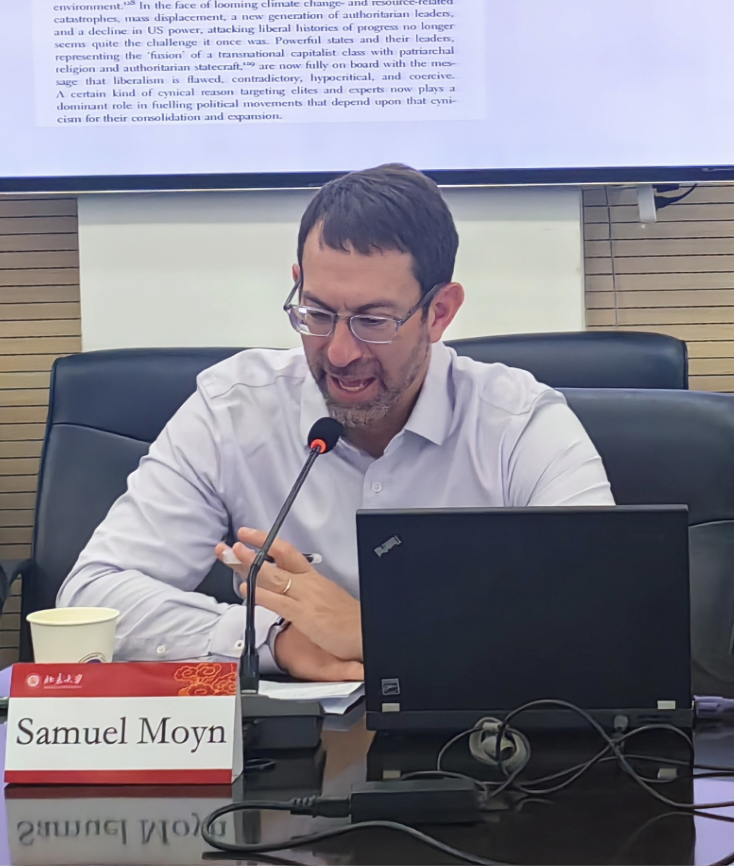
Professor Moyn used his own academic journey as a starting point to explore the proposition of “the historical turn in international law.” He noted that the term “historical turn” itself warrants reflection, as it primarily reflects the phenomenon of international law scholars choosing historical approaches during specific periods, whereas historians have always been rooted in the traditions of the historical discipline. Professor Moyn shared insights from his 2010 publication The Last Utopia: Human Rights in History, revealing that his primary aim was to engage with historians on the origins of human rights. His core interest lay in understanding how human rights evolved into a pervasive belief system, rather than initially framing it as a legal concept. Based on this research, Professor Moyn put forward a central argument: international law scholars often play the role of “trend followers” rather than pioneers in the history of human rights thought. Understanding history is crucial for understanding international law, but the reverse is not necessarily true, especially in the field of human rights history.
Second, Professor Moyn further proposes a “dual paradigm” theory of human rights evolution: The “Human Rights 1.0” paradigm (1776-1789), marked by the American and French Revolutions, centered on citizens establishing sovereign states through violent revolution, with demands focused on domestic civil rights rather than the suffering of others. Subsequently, Professor Moyn examines the central thesis of his subsequent work Not Enough: Human Rights in an Unequal World: the historical predicament of social rights and the structural contradictions within welfare state theory. Finally, addressing the methodological debate over the “historical turn” emerging within international law scholarship, Professor Moyn provides an in-depth analysis of the fundamental disagreements and shared understandings between historians and international legal scholars.
During the discussion session, Assistant Professor Zhang Kangle noted the plural forms of liberal internationalism, while Assistant Professor Chen Xiaohang focused on the dialogue impasse between historians and international legal scholars, highlighting the current disconnect where each side simplifies the other’s position while complicating their own. Postdoctoral Fellow Lin Zhaoran traced the history of disciplinary differentiation in the 19th century to understand the motivations behind the “historical turn.” Finally, Postdoctoral Fellow Huang Pengbei distinguished between historical and legal approaches to the study of international legal history. He argued that while acknowledging the binding force of historical context, it is essential to preserve international law’s normative power to shape the future.
Translated by: Hao Wanqing
Edited by: Shi Xiaoyu