



Exploring Developments in International Dispute Resolution and Rule of Law Practice under the Belt and Road Initiative: A Delegation from the AIFC Court and IAC Visits Peking University Law School
Date:2026-10-30
On April 3, 2026, a delegation visited Peking University Law School led by Mr. Christopher Campbell-Holt, Registrar and Chief Executive of the Astana International Financial Centre Court and International Arbitration Centre (AIFC Court and IAC) and a member of the International Commercial Expert Committee of the Supreme People’s Court of the People’s Republic of China, and Ms. Meray Ozat, Head of the AIFC Court and IAC’s Centre for Global Policy Leadership on Dispute Resolution and Rule of Law. The visitors took part in a seminar on the development of international dispute resolution mechanisms and experience in providing legal safeguards for international investment. The seminar was chaired by tenured A.P. Zhang Zhiyong of Peking University Law School. Participants included students from Peking University’s interdisciplinary joint undergraduate training program in Foreign-Related Rule of Law and Global Governance, as well as master’s and doctoral students specializing in international law and international economic law at the Law School.
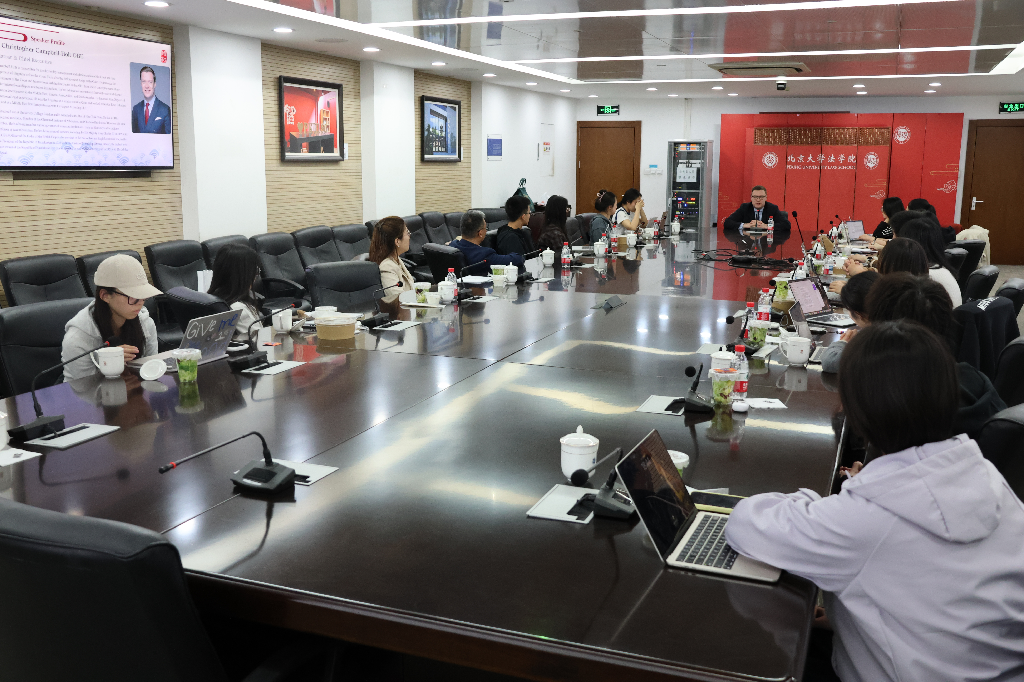
The seminar in progress
A.P. Zhang Zhiyong warmly welcomed the two guests and thanked the AIFC Court and IAC for supporting Peking University Law School’s education of legal professionals for international practice. He noted that, as cooperation under the Belt and Road Initiative deepens and cross-border investment and commercial exchanges expand, the coordinated development of dispute resolution mechanisms, including international commercial litigation, arbitration, and mediation, is becoming an increasingly important subject for both legal scholarship and practice. By focusing on the development of dispute resolution institutions in Central Asia, the seminar offered students a practical example through which to understand new developments in the rule of law in international commercial affairs.
In his keynote presentation, Mr. Campbell-Holt drew on his extensive experience in establishing and operating the AIFC Court and IAC to provide a systematic introduction to the development and institutional features of the Astana International Financial Centre’s dispute resolution mechanisms. He explained that, for emerging economies seeking to attract foreign direct investment, infrastructure development and innovation in business models are important. Even more important, however, is a stable, credible, efficient, and internationally trusted dispute resolution system that allows foreign investors to form reasonably stable expectations of investment returns and risks. With this goal in mind, the AIFC has gradually developed an institutional framework within a special area of Astana that combines an international commercial court, arbitration, and mediation, establishing a distinctive model of “one-stop dispute resolution.”
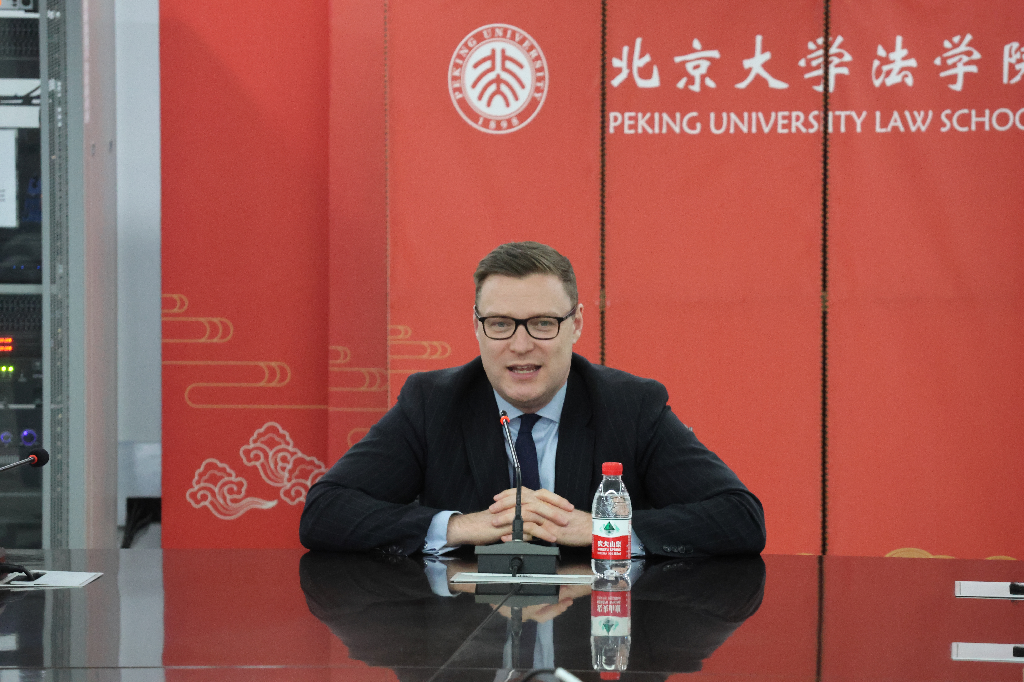
Mr. Christopher Campbell-Holt delivers his keynote presentation
Comparing litigation, arbitration, and mediation, Mr. Campbell-Holt highlighted differences in procedural design, cost management, confidentiality, and the preservation of business relationships. Arbitration, he noted, has long been favored by international commercial parties because they can choose their arbitrators and benefit from relatively flexible and confidential proceedings. Mediation, with its more adaptable procedures, relatively low costs, and greater potential to preserve relationships, is playing an increasingly valuable role in resolving modern commercial disputes. In his view, dispute resolution should be understood both as a remedy after a dispute arises and as an important institutional foundation for building investor confidence, improving the business environment, and fostering long-term cooperation.
Drawing on the specific experience of the AIFC Court and IAC, Mr. Campbell-Holt also discussed how high-quality dispute resolution mechanisms can respond to regional development needs through institutional design, an international judiciary, procedural rules, case management, and arrangements supporting enforcement. He further explored their significance for the business environment in Central Asia and for regional economic and trade cooperation. He particularly emphasized China’s increasingly important role in trade and investment cooperation in Central Asia, noting the considerable opportunities for Chinese legal professionals and young students to contribute to regional cooperation in dispute resolution.
During the question-and-answer session, students actively raised questions on the legitimacy of establishing special dispute resolution mechanisms through constitutional changes; practical challenges in building a regional dispute resolution platform among BRICS countries; the difficulties faced by newly established international dispute resolution centers and how they can gain investors’ trust; and personal experiences of working in the legal profession in Astana. Drawing on comparative experience in institutional development across different countries, Mr. Campbell-Holt addressed the practical obstacles facing international dispute resolution mechanisms in securing political support, establishing legal frameworks, obtaining budgetary resources, developing talent, and building credibility. He also shared his thoughts on professional development, broadening one’s international outlook, and adapting to different cultures.
He encouraged students to gain international experience and, while building a solid understanding of legal theory, actively learn how disputes are resolved in different jurisdictions, institutional settings, and business cultures, thereby continually strengthening their capacity for global legal practice. At the end of the lecture, he shared his own career experiences, encouraging students to remain resilient, humble, and open-minded, seize opportunities, and keep moving forward so that they might one day make greater contributions to society.
The seminar offered substantive discussion and a broad perspective. It deepened students’ understanding of how international commercial courts, arbitration, and mediation can work together, and provided a vivid case study of the development of the rule of law, improvements to the business environment in Central Asia, and practical cooperation in dispute resolution under the Belt and Road Initiative. Through the exchange, students gained a more concrete and multidimensional understanding of how international dispute resolution mechanisms can improve investment conditions, deepen regional cooperation, and strengthen legal capacity. The seminar concluded successfully with warm applause.
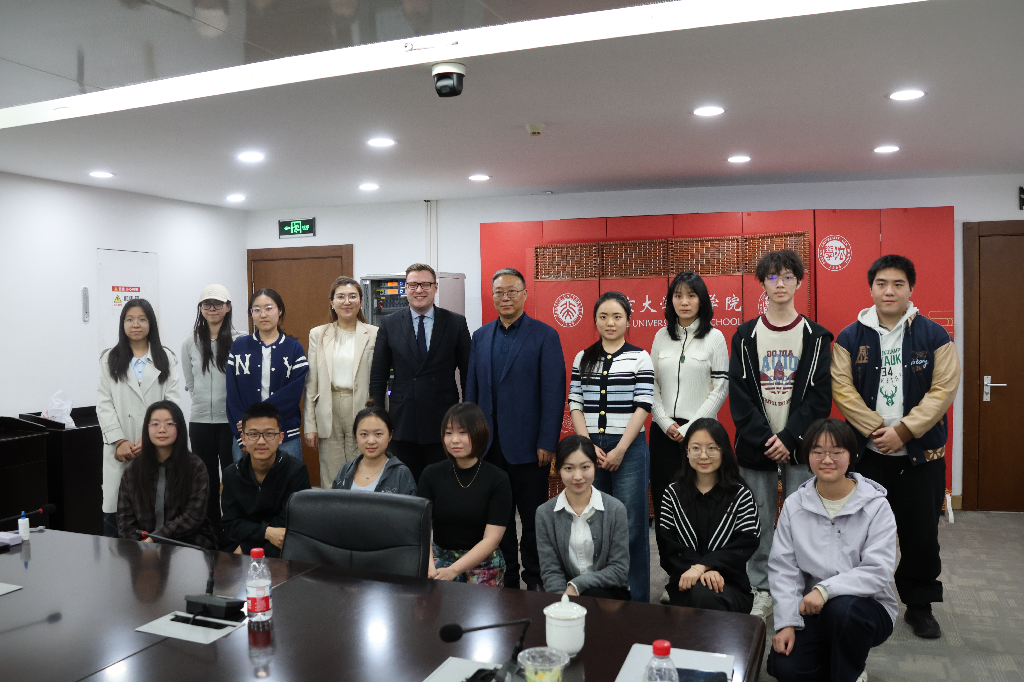
Faculty members, students, and guests pose for a group photo
Translated by Zhang Xinye