



Lecture Review: Leon Marcel Arno Kahl (Institute of Civil Procedure Law, University of Vienna, Austria): Approaches to Procedural Justice in Chinese and German Civil Procedure: A Comparative Study
Date:2025-05-28
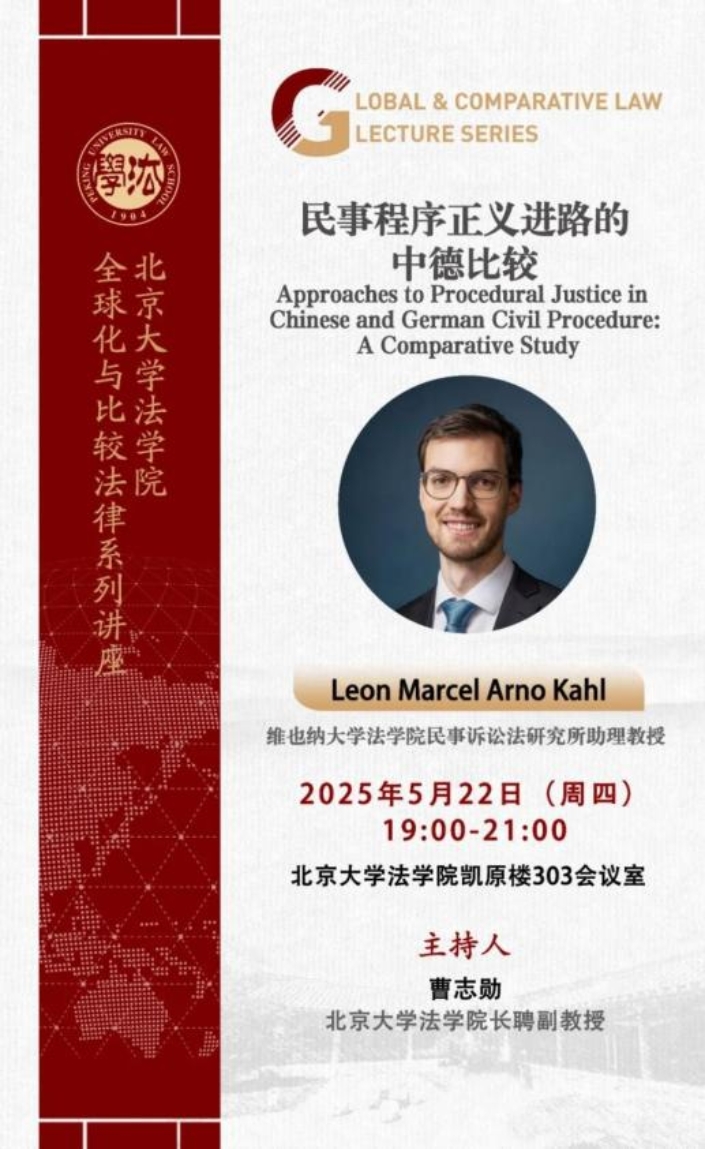
On May 22, 2025, the "Global Comparative Law Lecture Series" of Peking University Law School (PKULS) was held in Conference Room 303 of Koguan Building, PKULS. Dr. Leon Marcel Arno Kahl, Assistant Professor at the Institute of Civil Procedure Law, University of Vienna, Austria, delivered an academic report titled " Approaches to Procedural Justice in Chinese and German Civil Procedure: A Comparative Study". The lecture was hosted by A.P. Cao Zhixun, tenured associate professor of PKULS, with Prof. Fu Yulin and A.P. Liu Zhewei from PKULS as discussants, and Liu Zihe, Assistant Researcher at the School of Civil, Commercial and Economic Law of China University of Political Science and Law (CUPL), as a special guest.
This article presents the core points of the lecture in a verbatim transcript.
Leon Marcel Arno Kahl:
First, I explore the constituent elements of procedural justice from a theoretical perspective. From the perspective of fundamental rights, I believe the concept of procedural justice encompasses four dimensions: Access to Justice, Due Process, Right to be Heard, and Fair Trial. Under these dimensions, procedural justice includes several detailed requirements: Firstly, in the overall design of civil litigation procedures, the principle of non-discrimination must be implemented for foreign litigants, and private autonomy must be respected to the maximum extent while ensuring litigation efficiency; Secondly, in the process of institutional formation, the principles of neutrality and rationality should be implemented, and the exercise of discretion should be regulated within the framework of the rule of law; Thirdly, adjudicators in individual cases should remain independent and impartial, make rulings within a reasonable time frame on the basis of ensuring parties' procedural participation and full expression, and avoid delays; Fourthly, regarding the balance of procedural interests, priority should be given to providing inclined protection to vulnerable groups through means such as legal aid and deferred payment of litigation costs, and reducing the procedural burden on disadvantaged litigants in small claims.
Secondly, from the perspective of interdisciplinary research in departmental law, I will share four cases in European law to introduce the dispute between procedural justice and substantive justice in litigation.
The first case is the Frederike Möhlmann case. The defendant Möhlmann was accused of murder in the 1980s but was acquitted due to insufficient evidence. After the introduction of DNA identification technology in 2012, new evidence emerged proving that Möhlmann was the perpetrator. Regarding whether the principle of double jeopardy can be breached to allow a retrial, the Federal Court of Justice of Germany held a negative opinion in its judgment. This reflects the attitude that under the perspective of weighing constitutional fundamental rights, the procedural right to justice embodied in the prohibition of double jeopardy is more important than achieving the substantive justice result of conviction and sentencing.
The second case is a sales contract dispute heard by the Federal Constitutional Court of Germany. In this case, the plaintiff sued the defendant for payment of the price. The defendant applied for legal aid due to lack of financial capacity and requested an expensive appraisal of the quality of the goods delivered by the plaintiff, with the court advancing the appraisal fees. Because the defendant failed to promptly report changes in his financial capacity, the legal aid was revoked. According to the provisions of the German Code of Civil Procedure, without legal aid, the defendant is the primary liable party for the appraisal fees, and the plaintiff is the secondary liable party. Since the defendant had no financial capacity, the appraisal fees, which were much higher than the subject matter of the lawsuit, would be borne by the successful plaintiff. The plaintiff therefore filed a constitutional lawsuit. The Federal Constitutional Court of Germany ruled that after one party obtains legal aid in accordance with the basic requirements of access to justice, the state's interest in collecting judicial fees from both parties is subordinate to the other party's interest in obtaining substantive remedy protection.
The third case is Tolstoy v. United Kingdom. Tolstoy was civilly sued for defamation and lost the first instance. When Tolstoy filed an appeal to the second instance, the UK court granted the plaintiff's application for Security for Costs, requiring Tolstoy to prepay 125,000 euros to initiate the appeal. The court considered the substantive possibility of reversing the judgment in the second instance during the appeal review. Tolstoy was unable to file the appeal because he failed to prepay the high security for costs. Tolstoy then resorted to the European Court of Human Rights but was still dismissed. The European Court of Human Rights held that considering the function of the appeal system in the overall civil litigation procedure, security for costs can prevent appellants from filing obviously frivolous appeals that cause irreparable litigation cost losses to the appellee. Given that the first instance lasted 40 days and the review of the aforementioned security for costs had lasted 7 days, it was reasonable and necessary for the court to set certain appeal thresholds.
The fourth case is Garcia v. Spain. Ms. Garcia lost a traffic accident dispute and filed an appeal to the second instance. In accordance with the provisions of the Spanish Code of Civil Procedure, since Ms. Garcia's application for legal aid was rejected, initiating the second instance remedy required prepaying the amount of the first instance judgment. Unable to pay, Ms. Garcia filed a constitutional lawsuit seeking to file the appeal without paying the corresponding amount, but was dismissed. Finally, Ms. Garcia continued to appeal and was supported by the European Court of Human Rights. The European Court of Human Rights held that the Spanish court's rule restricting appeals aimed to reduce the case pressure on appellate courts, but this restriction must not substantially deprive parties of the right to obtain second instance remedy.
Finally, from the perspective of global comparative civil litigation functions, I would like to discuss the subjective and objective scope of res judicata in Chinese civil litigation. Regarding the subjective scope of res judicata, under Chinese law, considering that plaintiffs and defendants may further sue third parties after the conclusion of the disputed case, resulting in the judgment having a factual impact on third parties not participating in the previous litigation, a unique system of third-party revocation action has been designed. This scheme breaks through the traditional view that res judicata is limited to the parties, resulting in no strict subjective scope of res judicata under Chinese law; Regarding the objective scope of res judicata, different jurisdictions adopt different technical standards. For example, the United States adopts the Issue Preclusion rule, Germany adopts the Claim Preclusion rule, while China adopts the Legal Basis Preclusion rule. Its objective scope of res judicata is narrower. After a party initiates a claim for compensation for breach of contract based on a contract, it can still litigate the same incident and the same amount again based on other claim bases (such as unjust enrichment).
The second unit of the lecture was the discussion session
Fu Yulin:
Thank you, Dr. Kahl, for sharing some very interesting topics. He is quite familiar with China's retrial system and put forward critical thoughts that are also discussed in Chinese academic circles. In fact, due to the lack of restrictions, the frequency of parties applying for retrial in China is increasing, making it almost a regular remedy procedure. I also agree with his view that substantive justice should be balanced with procedural justice.
Liu Zhewei:
Twenty years ago, when China's judicial reform was in full swing, procedural justice was an important goal pursued by the judicial reform. But today, the academic and practical circles of civil procedure law in China pay more attention to specific value goals such as efficiency and openness. This may be because in criminal litigation, procedural justice has a clear goal, which is to protect citizens from infringement by the improper exercise of public power. In civil litigation, however, due to the equality of the parties' status, the specific goal of procedural justice is no longer clear. For example, a litigant's litigation act may increase the burden on other parties, and restricting their act will in turn protect the interests of other parties. Therefore, contemporary Chinese civil judicial reform and civil procedure law research will focus more on micro-level factors affecting judges' decisions, such as the "large number of cases and few judges", litigation efficiency, including res judicata.
Liu Zihe:
Scholars from all countries are well aware of the importance of res judicata, but perhaps only Chinese scholars pay so much attention to contradictory judgments. Do German or European scholars conduct more research on this concept? In addition, should there be specific rules to ensure procedural justice?
Leon Marcel Arno Kahl:
Germany does recognize the existence of "contradictory judgments" in the Chinese legal sense. For example, the validity of a housing lease contract in the previous lawsuit was only examined as a ground for judgment, and the judge ruled that the defendant should perform the obligation on the basis of the contract's validity; In the subsequent lawsuit, the contract was deemed invalid by the court, resulting in a "contradictory judgment" at this time. German courts believe that it is only a contradiction in grounds, not a substantive contradiction, because there is no final judgment on the validity of the contract. Even if the issue of contract validity in the subsequent lawsuit falls within the scope of res judicata (for example, through an interim declaratory judgment), there is no need for retrial of the previous judgment, and the two judgments can coexist. The reason why parties may file an interim declaratory judgment is that for lease contracts, there is also the issue of the temporal effect of res judicata: the claim for rent payment between parties within a certain period of time will be divided into different parts by successive payment claims, which will be finally resolved by different judgments. Regarding the issue of ensuring procedural justice through specific rules, we pay too much attention to access to justice and neglect the security for costs system. However, procedural justice is an overall concept, and access to justice is only one element of procedural justice. We should not only focus on the plaintiff and ignore the defendant, but need to balance the interests of different parties.
Cao Zhixun:

Procedural justice is also an extensively studied topic in China. Researchers in China's procedural law, such as Prof. Chen Ruihua, have also influential argued earlier that procedural justice has its own independent value, and in some cases, procedural justice may be more important than substantive justice. As mentioned by Dr. Kahl in the criminal litigation cases, similar principles exist in civil litigation. As a classic topic, procedural justice can always find new examples. When studying procedural justice, Dr. Kahl spans multiple interdisciplinary fields such as civil law, criminal law, and constitutional law, and points out the dilemma of balancing interests among different litigation participants. Applying the principle of proportionality to procedural justice breaks through the boundaries between various departmental laws and constitutional law, responds to the hot topics in current international comparative procedural law research, and echoes the theme of the 5th Peking University Summer School on Comparative Civil Procedure Law, which will kick off in July, from one aspect.
Translated by:Han Kaibo
Edited by: Lu Zhixuan