



Anne Peters: The Emotional Dynamics in International Law
Date:2025-06-16
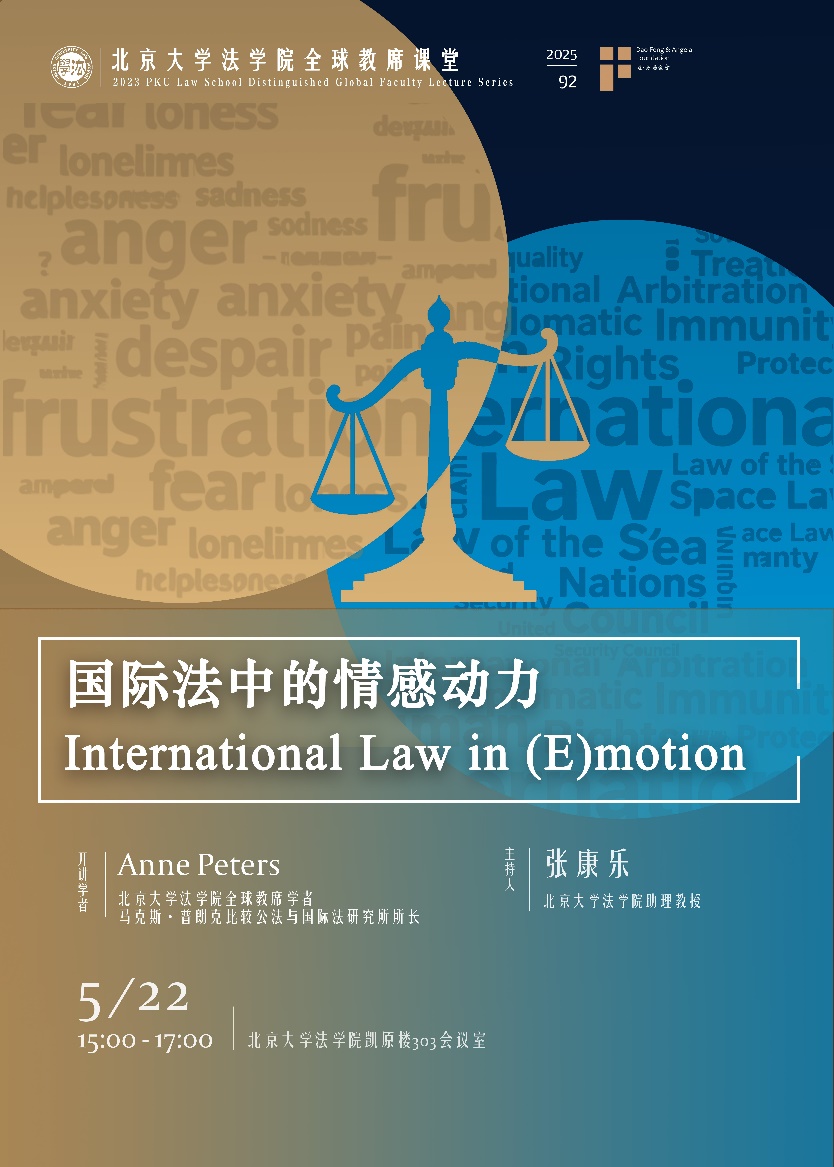
On May 22, the 92nd lecture of the Global Chair Series, titled “International Law in (E)motion,” was successfully held at the Koguan Building of Peking University Law School. Organized by Peking University Law School, the lecture featured Professor Anne Peters, Director of the Max Planck Institute for Comparative Public Law and International Law and Professor Emeritus at the University of Munich Law School. Assistant Professors Liu Yang from Renmin University of China Law School, Zhao Lizhi from Beijing Foreign Studies University Law School, and Chen Xiaohang from Peking University Law School, along with Lecturer Cao Wenjiao from the Department of International Law at the China Foreign Affairs University and Postdoctoral Researcher Lin Zhaoran from Peking University Law School/Institute of Ocean Law, participated as discussants. The lecture was moderated by Assistant Professor Zhang Kangle from Peking University Law School. Dozens of faculty and students attended the lecture on-site, generating enthusiastic responses.
In this lecture, Professor Peters delivered an in-depth exposition on the role of “emotion” in international law. She noted that while international law has traditionally centered on rationality, norms, and rules, emotion—as an indispensable psychological and social phenomenon for legal subjects—has long been overlooked by academia. She emphasized that emotion not only shapes the behavioral motivations of international legal subjects but also profoundly influences the formation and evolution of the international legal order. Reviewing the disciplinary development of international law, she highlighted how emotion studies—spanning psychology, anthropology, and sociology—inject fresh perspectives into international legal theory. She argued that emotion research enables us to transcend traditional rationalist frameworks, revealing how international law gains recognition and compliance across diverse cultural contexts.
During the discussion session, Professor Liu Yang questioned the normative foundation and subject attribution of the core assumption of “universal emotions in law,” stressing the need to clarify the definition of ‘law’ and “whose emotions” to avoid research falling into power traps. Professor Zhao Lizhi examined the specific mechanisms of emotions as components of rational decision-making in judicial practice through International Court of Justice boundary dispute cases, particularly focusing on the shaping power of postcolonial nations' emotions on legal interpretation. Professor Cao Wenjiao proposed a framework for analyzing the differential weighting of emotions across domains, highlighting the instrumental value of emotions in survival-related fields like human rights law and humanitarian law, as well as in emerging rule-based areas such as climate change law. She cautioned that the politicization of emotions could fuel populist risks. Professor Lin Zhaoran proposed integrating the history of emotions, aesthetics, and feminist theory to deconstruct the rational/emotional dichotomy. Using the colonial and decolonial emotional mobilization around the concept of “civilization” as an example, he suggested tracing the ideological evolution of emotional symbols through micro-analysis of 19th-century scholarly texts. Professor Chen Xiaohang employed a three-dimensional analytical framework (emotion's presence in international law/as a driving force within international law/as an external critique of international law) to interrogate the theoretical dilemma of the discipline's systemic neglect of emotion, questioning the appropriate level of inquiry for addressing this gap. Professor Anne Peters listened to the discussions and suggestions from all faculty members and responded to questions raised by both faculty and students.
Translated by: Hao Wanqing
Edited by: Lu Zhixuan