



Distinguished Global Faculty Lecture Series
Date:2026-07-10
Distinguished Global Faculty Lecture Series
Taisu Zhang, The Behavioral Logic of Legal Internalism
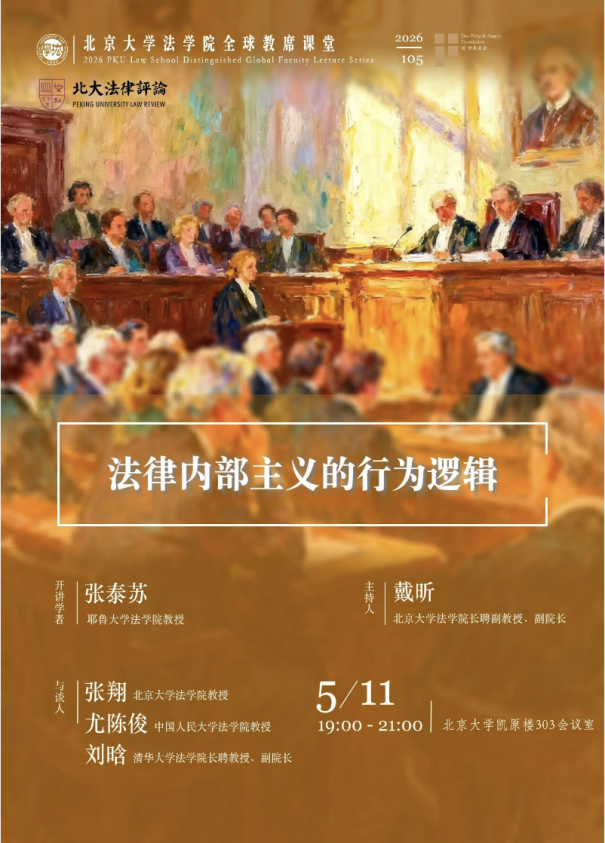
On May 11, 2026, Professor Zhang Taisu hosted an an academic salon titled “The Behavioral Logic of Legal Internalism” at Peking University. In this lecture, he presented research co-authored with Columbia’s Shyamkrishna Balganesh, defining “legal internalism” as a behavioral pattern among legal professionals: treating law as normatively independent, favoring internal legal reasoning over external (political/social) factors, and pursuing conceptual coherence. He distinguished internalism from formalism—the former is a behavioral pattern, not a belief—and argued internalism persists because it serves the legal profession’s collective interests: enhancing authority, protecting interpretive monopoly, and reinforcing professional barriers via specialized knowledge. He proposed mechanisms linking group interest to individual behavior (rational choice, strong/weak cognitive bias) and rebutted alternative explanations, citing evidence from China’s legal professionalization and the rise of “legal dogmatics.”
For more information on this lecture, please visit:
https://www.law.pku.edu.cn/xwzx/xwdt/10cdd02c8067443e889fe82fa59a5d42.htm
Eric Hilgendorf, The Theory of Legal Interests --- Old Challenges and New Perspectives
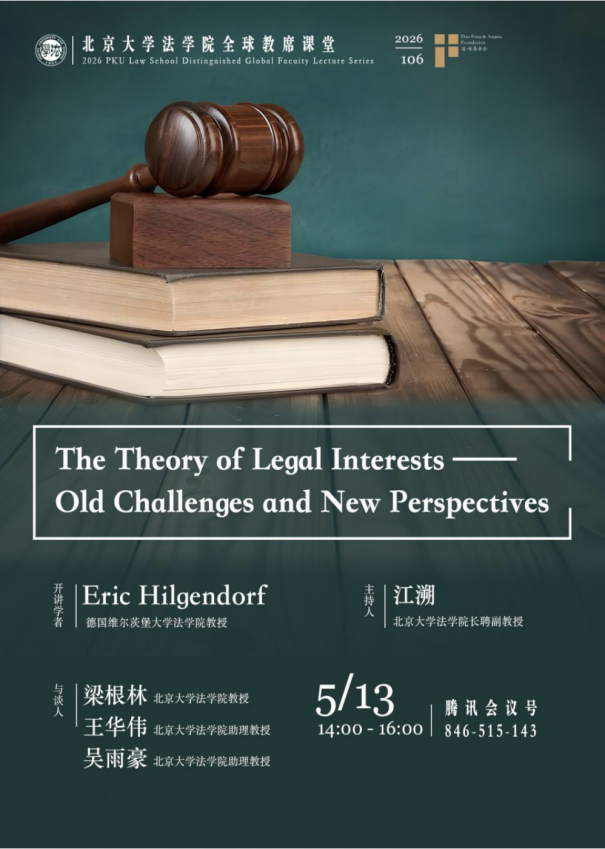
On May 13, 2026, Professor Eric Hilgendorf of the University of Würzburg delivered an online lecture at Peking University Law School on the concept of “legal interests” (Rechtsgut) in criminal law. He traced the idea from Enlightenment origins through thinkers such as Feuerbach, Birnbaum, and Liszt, and surveyed modern theories by Hassemer, Amelung, Jakobs, and Roxin. The lecture’s central tension formulated around proposing formalist and critically systemic perspectives. He concluded that while legal interest theory has limited power to constrain legislative discretion, it remains indispensable for criminal policy discourse, statutory interpretation, and the systematic organization of criminal law.
For more information on this lecture, please visit:
https://www.law.pku.edu.cn/xwzx/xwdt/a8c177e001c34560ad6b6dd94f68e043.htm
Henk Vording, The Reform of Tax Allocation Norms: Pillar Two and the Side-by-Side Package

On May 19, 2026, Professor Henk Vording of Leiden University Law School delivered a lecture at Peking University Law School on reforming international tax allocation rules. He traced the foundations of the 1920s international tax consensus — built around permanent establishment rules, the arm’s length principle, and residence-country priority — and explained how the rise of intangible assets and digital business models exposed its fundamental flaws, enabling double non-taxation and large-scale profit shifting. He then examined the OECD’s BEPS 2.0 two-pillar framework: Pillar One, which reallocates taxing rights over excess profits to market jurisdictions (though its prospects remain uncertain), and Pillar Two, which establishes a 15% global minimum tax through top-up mechanisms including QDMTT, IIR, and UTPR. He concluded by discussing the recently adopted Side-by-Side Package, which emerged from US-EU tensions over GILTI’s compatibility with Pillar Two, and its implications for countries like China that currently lack a GILTI-equivalent regime.
For more information on this lecture, please visit:
https://www.law.pku.edu.cn/xwzx/xwdt/1ce5077eb1824d4d800d224adefe0644.htm
Henk Vording: EU Minimum Tax and Anti-Tax Avoidance Rules: Implications for Chinese Investors
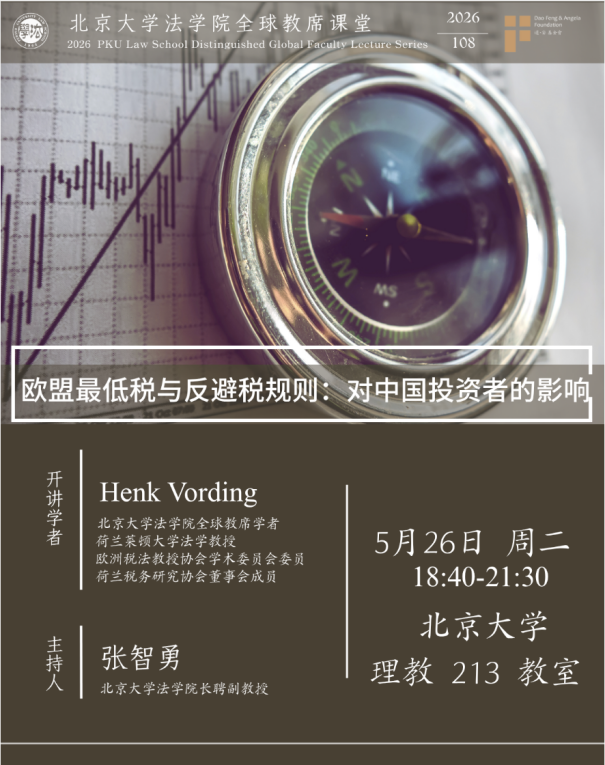
On May 26, 2026, Professor Henk Vording of Leiden University delivered a lecture at Peking University Law School examining EU corporate tax rules from the perspective of Chinese investors. He analyzed two key EU directives: the Anti-Tax Avoidance Directive (ATAD) and the Global Minimum Tax Directive. Walking through ATAD’s four core mechanisms — the interest limitation rule (capping deductions at 30% of EBITDA), the general anti-abuse rule (targeting artificial arrangements lacking commercial substance), the CFC rule (reallocating passive income from low-tax subsidiaries to parent companies), and the hybrid mismatch rule (preventing double non-taxation through mismatched characterizations) — he assessed how each interacts with Pillar Two’s 15% minimum effective tax rate. He concluded that while the global minimum tax narrows the scope of many anti-avoidance rules, letterbox companies in tax havens and aggressive CFC planning remain areas of ongoing risk, and that Chinese investors entering the EU must ensure their structures comply with both ATAD and Pillar Two, particularly where the Side-by-Side Package or UTPR may apply.
For more information on this lecture, please visit:
https://www.law.pku.edu.cn/xwzx/xwdt/19b4ae4e438c40f998506f169c934641.htm
Benjamin Liebman, Chinese Judicial Transparency under a Comparative Law Perspective
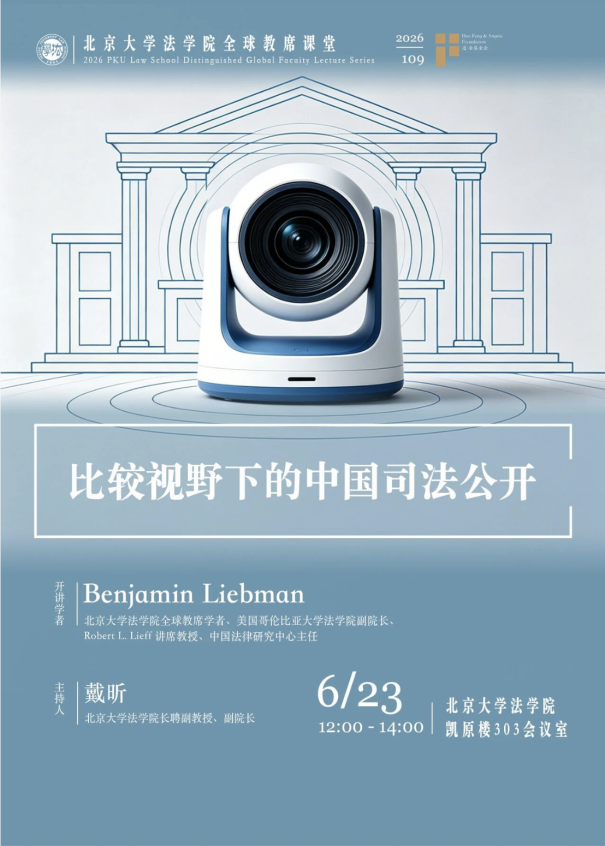
On June 23, 2026, Professor Benjamin Liebman from Columbia Law School delivered a lecture titled Judicial Transparency in China from a Comparative Perspective as part of the Distinguished Global Faculty Lecture Series at Peking University Law School, with Vice Dean Dai Xin presiding. Drawing on over a decade of data, Benjamin Liebman compared the development of judicial transparency at home and abroad, analyzing the evolution of China’s judicial disclosure, misuse of judicial data and adjustments to disclosure platforms, alongside the problematic transparency practices in the United States. Professors Zhang Qi, Wang Xixin, Peng Chun and other scholars offered comments, discussing theoretical logic, evaluation dimensions, document screening rules and the recognition of reliance interests, and pointed out that this topic bears great theoretical value and potential for empirical research.
For more information on this lecture, please visit:
https://www.law.pku.edu.cn/xwzx/xwdt/4628cc0005fe49f98ad8c18dd5d7cd47.htm
Benjamin Liebman, The United States Supreme Court: A “Brake” or an “Accelerator” for the Trump Administration?
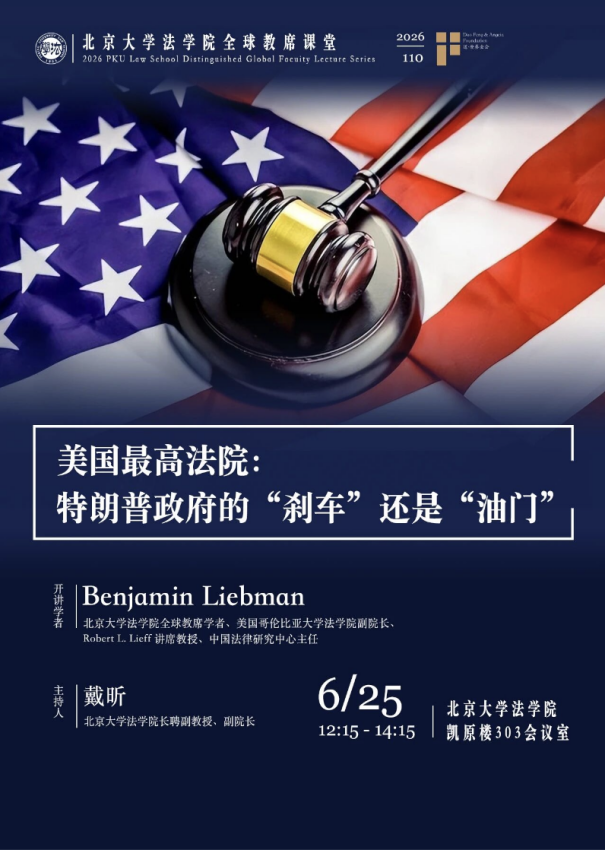
On June 25, 2026, Professor Benjamin Liebman, Vice Dean of Columbia Law School, delivered a lecture at Peking University Law School analyzing the Supreme Court’s has function for the Trump administration. He analyzed the Court’s expanded use of the shadow docket, its retreat from voting rights protections in gerrymandering cases, and its deference to expansive executive power following the overruling of Chevron deference. While Trump lost high-profile cases on tariffs and birthright citizenship, Liebman argued these losses paradoxically legitimized previously fringe legal arguments. He identified the abdication of Congress — not the courts — as the root cause of weakening constitutional checks and balances.
For more information on this lecture, please visit:
https://www.law.pku.edu.cn/xwzx/xwdt/af8400468c794a8bbf9d8ab1b9e79629.htm