



【Lecture Notice】Matthias Goldmann: From Liberal International Law to the International Law of Equals
Date:2026-09-30
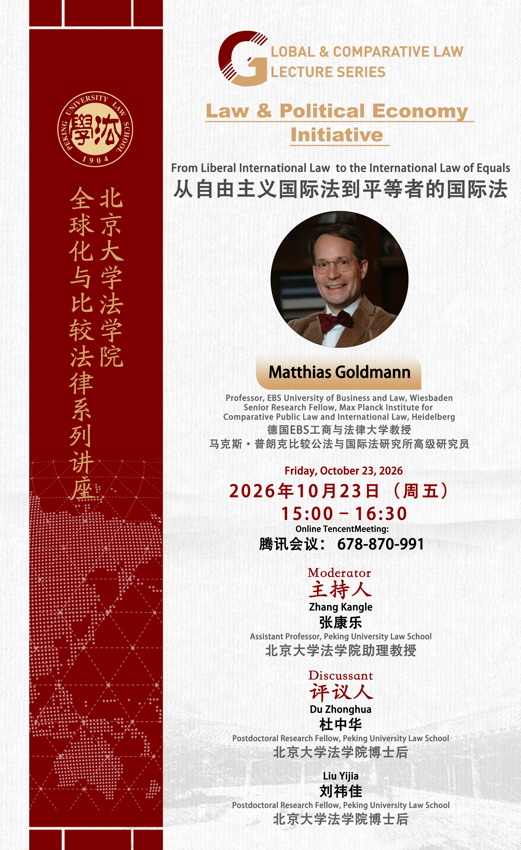
Topic: From Liberal International Law to the International Law of Equals
Time: 15:00‑16:30, Friday, October 23, 2026 (Beijing) | 09:00–10:30 CEST
Format: Tencent Meeting 678-870-991
Speaker: Matthias Goldmann
Moderator: Kangle Zhang, Assistant Professor, Peking University Law School
Discussant: Zhonghua Du, Postdoctoral Research Fellow, Peking University Law School
Yijia Liu, Postdoctoral Research Fellow, Peking University Law School
Speaker Biography:
Matthias Goldmann, Dr. iur., LL.M. (NYU), holds the Chair of International Law at EBS University of Business and Law in Wiesbaden and is a Senior Research Fellow at the Max Planck Institute for Comparative Public Law and International Law in Heidelberg. He studied law and European law at the University of Würzburg and the University of Fribourg, completed an LL.M. at New York University School of Law, and received his doctorate in law from Heidelberg University. From 2016 to 2021 he was Junior Professor of International Public Law and Financial Law at Goethe University Frankfurt, and in 2015 he was awarded a Freigeist Fellowship of the Volkswagen Foundation. He served as an editor and editor-in-chief of the German Law Journal from 2017 to 2022.
His research focuses on the law and political economy of finance, economic constitutionalism, and the theory and history of European and international law, with particular attention to their colonial dimensions. He is the author of Internationale öffentliche Gewalt: Handlungsformen internationaler Institutionen im Zeitalter der Globalisierung (Springer, 2015), and his book The Constitution of Capital: A Study in Law and Political Economy is forthcoming with Oxford University Press. Recent work includes ‘The Ambiguity of Colonial International Law: Three Approaches to the Namibian Genocide’ (Leiden Journal of International Law, 2024) and, closely related to the theme of this lecture, ‘International Law of Equals: Social Equality as a Realistic Alternative to Oligarchy and Great Power Politics’ (Verfassungsblog, 2026).
Abstract:
International law is in crisis. Not because certain big (and not so big) powers show frequent disrespect for international law and wage war in blatant violation of its most basic rules, but because the political economy that has sustained the liberal international legal order since the end of the Cold War no longer exists. This has to do with major changes in the worldwide economy and the economic structure of powerful states, which are increasingly characterized by oligopolies, inequalities, and a declining appetite for global competition. Particularly the United States, as the former anchor of the international legal order, no longer has a lasting interest in an open, liberal economy supported by an equally liberal international order. Instead, it has shifted towards a policy that favors spheres of influence and economic interventionism (instead of the former democratic interventionism). The structural causes of this shift reach beyond the Trump presidency.
For many states in the world, the decline of the old international legal order is a dangerous development. To participate in big power politics might undermine their very own constitutional structures, as violations of international law frequently are entangled with a decline in the rule of law and democracy. This has been described as the "boomerang effect" since colonial times by writers like Aimé Césaire and Hannah Arendt. The current conflicts in the Middle East provide ample evidence for the corruptive effect that violations of international law have on the rule of law, in particular free speech, the freedom of artistic expression, and the freedom of research.
Nevertheless, a credible alternative to the liberal international order is currently lacking. Any new international legal order beyond big power politics and spheres of influence would need to focus on equality. In fact, as a brief review of some episodes in international legal history shows, international law has worked fairly well to the extent that a high level of material equality existed both among states and among citizens. Largely sidelined by the liberal international legal order, a functioning international legal order for the 21st century needs to put equality center-stage.