



Recap of Global Chair Lecture No. 98 Prof. Sean Cooney: Occupational Health and Safety and Mental Wellbeing
Date:2025-09-23
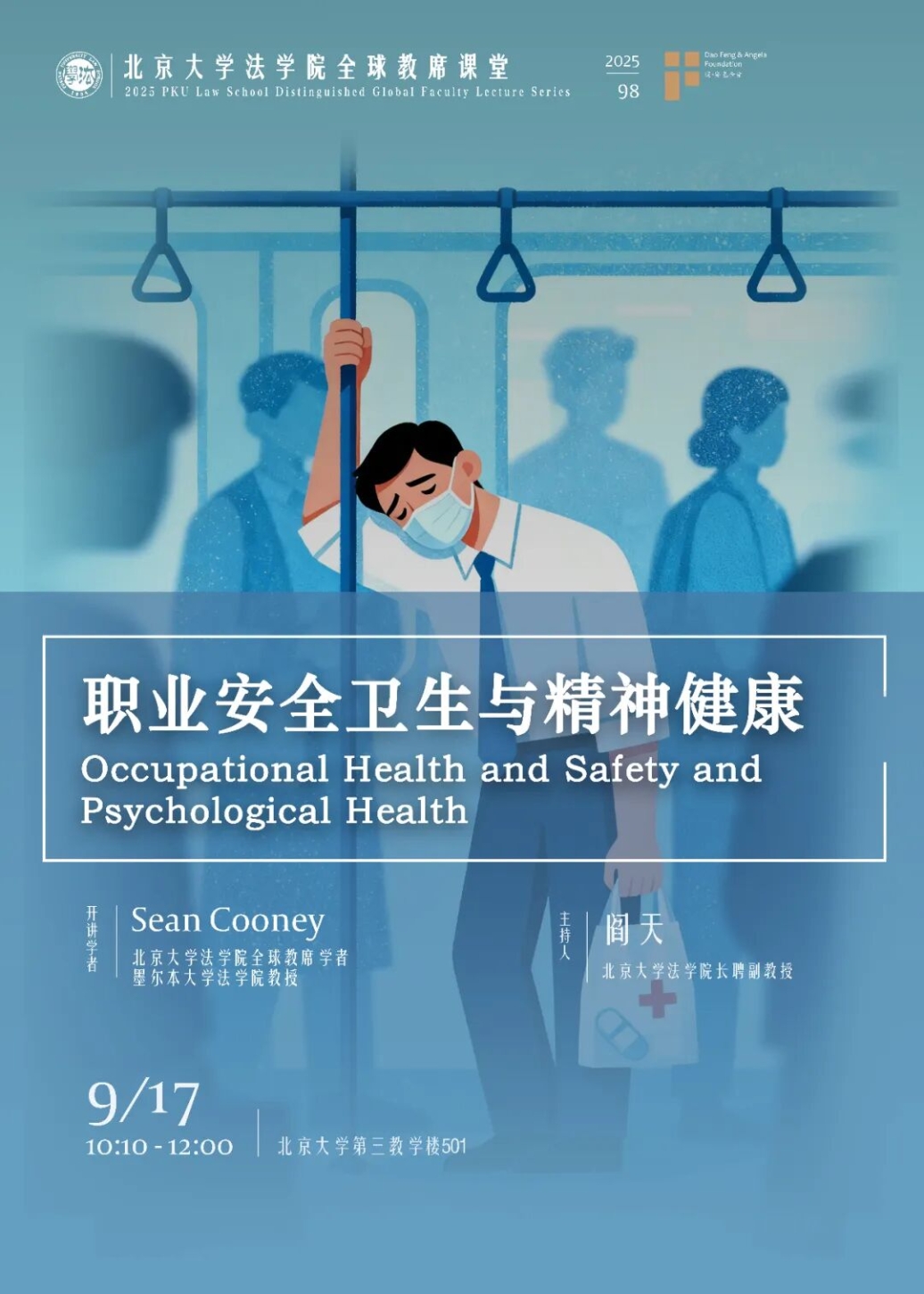
On September 17, 2025, Prof. Sean Cooney, Global Chair Scholar at Peking University Law School and Professor at Melbourne Law School, University of Melbourne, delivered an academic lecture titled “Occupational Health and Safety and Mental Wellbeing.” The lecture was moderated by Yan Tian, Tenured Associate Professor at Peking University Law School (PKULS). Nearly 100 students actively engaged with the speaker in a dynamic Q&A session, generating enthusiastic responses.
Prof. Sean Cooney’s Remarks
Australian labour law provides systemic protection against “psychosocial hazards” that workers encounter in the workplace. Under Australia’s Work Health and Safety Act (WHS Act) and its accompanying regulations, “psychosocial hazards” refer to risks arising from work design, work environment, equipment, or interpersonal interactions that may cause “psychological injury.” Such injuries include clinical conditions like anxiety disorders, depression, and post-traumatic stress disorder (PTSD).
In contemporary workplaces, while high-risk physical injuries have significantly declined, persistent stress stemming from poor workplace relationships, violence and harassment, and unreasonable job demands poses a systemic threat to workers’ mental and physical health. Recognizing this, Australian law has formally integrated psychosocial risks into its occupational health and safety governance framework.
Notably, the WHS Act does not adopt the traditional “employer–employee” binary framework. Instead, its protective scope is broadly applicable: it covers not only employees in standard employment relationships but also individuals in non-standard work arrangements—including gig workers and independent contractors. The Act defines duty holders as any person “conducting a business or undertaking” (PCBU), thereby encompassing sole traders, corporations, public institutions, and other entities. These duty holders are legally required to ensure, so far as is reasonably practicable, the health and safety of both their workers and any other persons affected by their operations.
The WHS Act establishes a comprehensive system of duties and worker participation mechanisms.
Building upon the WHS framework, Australia’s Fair Work Act provides supplementary protections addressing workplace stress, primarily through three mechanisms: flexible work arrangements, the “right to disconnect,” and collective bargaining.
Q&A Session
*Q1: How effective is the enforcement of the Work Health and Safety Act in practice, and what enforcement tools are available?
A: The WHS Act occupies a central role in Australia’s labour law system and is backed by multiple enforcement mechanisms. First, employers who breach statutory duties may face interventions by workplace regulators, including fines, compliance orders, and public disclosure of violations. Second, within enterprises, Health and Safety Representatives—elected by workers—have the authority to issue stop-work directions and file complaints with regulatory bodies.
Q2: Under the “right to disconnect,” employees may refuse after-hours contact unless the refusal is “unreasonable.” How is this “unreasonableness” determined?
A: The Fair Work Commission has developed a substantial body of case law on this issue. Determinations rely heavily on established precedents. Importantly, the effective implementation of the right to disconnect in Australia stems not only from legal provisions but also from supportive social norms and economic conditions. Australia’s strong economic foundation enables a more feasible work–life balance in practice.
Q3: When claiming compensation for psychosocial harm, do standard employees and gig workers face different treatment under the law?
A: Due to Australia’s federal system, workers’ compensation schemes are administered at the state and territory level, resulting in jurisdictional variations. Some states include gig workers within their compensation frameworks, while others do not.
Q4: Could legal efforts to protect mental health inadvertently foster a more repressive workplace culture? While prohibitions on offensive speech prevent harassment, they may also chill open expression. If legal standards keep rising, might the workplace become overly constrained?
A: This concern is valid, particularly because judgments about workplace speech often involve significant subjectivity. There is growing critique of “excessive risk aversion” in workplace regulation. A more balanced approach may lie not in rigid legal mandates, but in fostering transparent, good-faith dialogue between employers and workers—seeking equilibrium between rights protection and a healthy, open workplace culture.
Translated by: Tian Yuxin
Edited by: Shi Xiaoyu