



Global & Comparative Law Lecture Series
Date:2026-07-10
Global & Comparative Law Lecture Series
Martin Borowski, Balancing Alternative Means
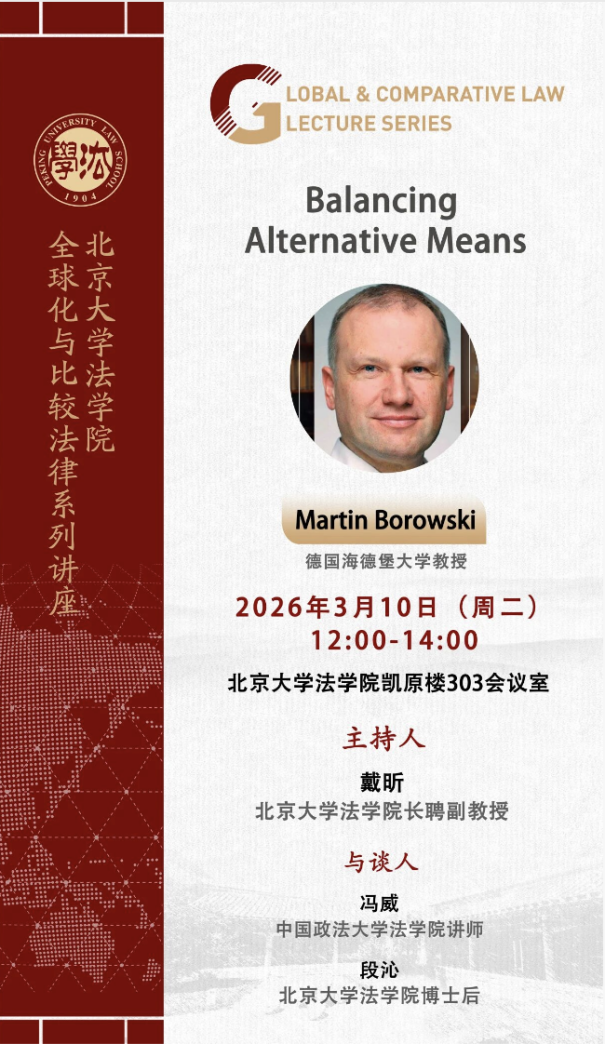
On March 10, 2026, Professor Martin Borowski of Heidelberg University lectured on proportionality in constitutional rights adjudication. He examined the classical three-part structure of appropriateness, necessity, and proportionality stricto sensu, identifying two under-explored categories of alternative measures: those that are not the least restrictive but yield a better overall cost-benefit ratio, and those that shift burdens to other rights-holders or third parties. He proposed expanding the second sub-principle of proportionality to accommodate these cases, while noting that most cases can still be resolved through traditional analysis.
For more information on this lecture, please visit:
https://www.law.pku.edu.cn/xwzx/xwdt/68088adcc0234380aaff8c7b7e69f186.htm
Gilad Abiri, Beyond True and False: AI and Epistemic Divide
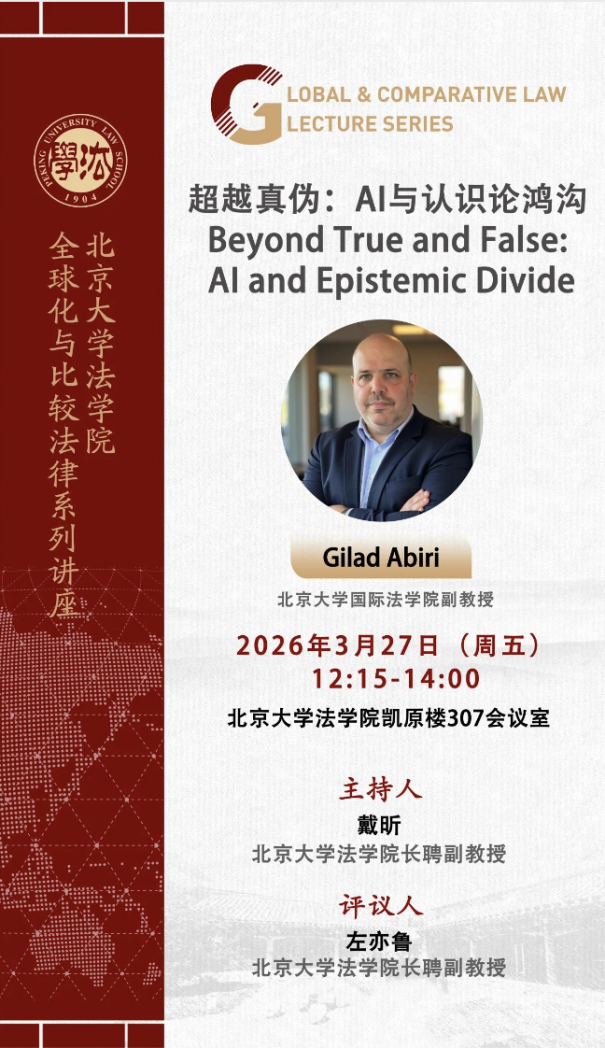
Professor Gilad Abiri argued that truth-based disinformation governance — content moderation, fact-checking, and transparency labeling — has failed because public trust in knowledge-producing institutions has collapsed. He proposed reorienting regulation toward rebuilding common institutional trust rather than adjudicating truth. He further analyzed how generative AI deepens the epistemic divide through industrialized disinformation and the “liar’s dividend”, while also threatening the internal integrity of academic and scientific institutions. He offered three remedies: reconstructing shared cognitive infrastructure, providing legal support for epistemic authority, and long-term cultural investment in knowledge institutions.
For more information on this lecture, please visit:
https://www.law.pku.edu.cn/xwzx/xwdt/6adc3153cdf74444841c196bd2a52079.htm
Christoph Kern, Revisiting the Relationship between Civil Law and Procedural Law from the Perspective of Dispute Resolution
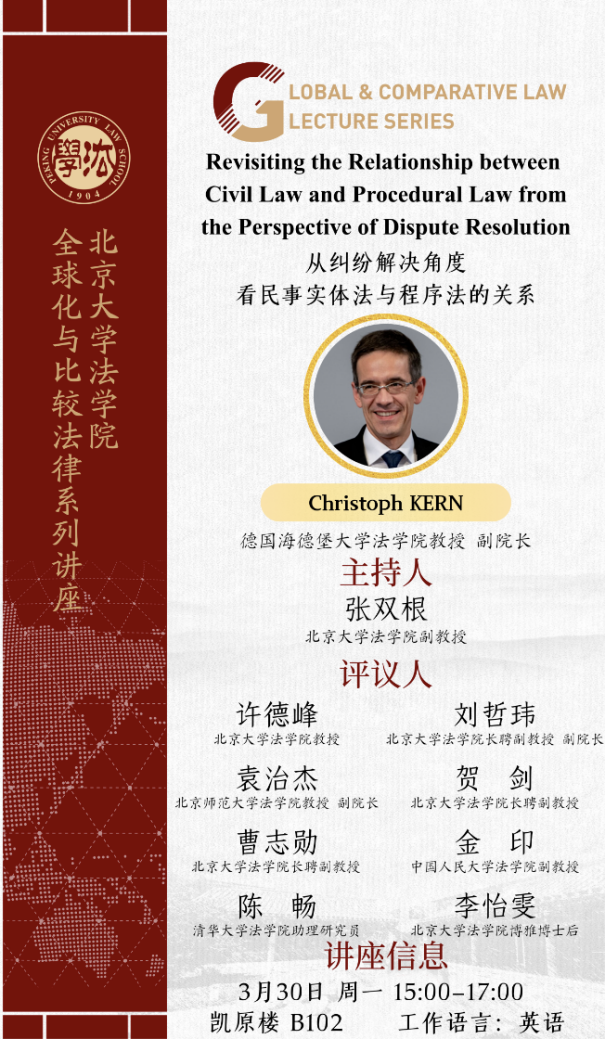
On March 30, 2026, Professor Christoph Kern of Heidelberg University analyzed the relationship between substantive civil law and civil procedure through the lens of dispute resolution. He distinguished procedure’s dynamic character from substantive law’s static focus on fixed historical facts, and traced 19th-century theoretical separation of the two domains via the deconstruction of the Roman actio. Despite this theoretical divide, he showed how the two domains intertwine in practice — through burden of proof, standing rules, and parties’ anticipatory behavior — arguing that both jointly serve the goals of justice and efficiency.
For more information on this lecture, please visit:
https://www.law.pku.edu.cn/xwzx/xwdt/49742e9128a145c8a246fa887239f587.htm
Gentian Zyberi, Trends and Developments in International Human Rights Law
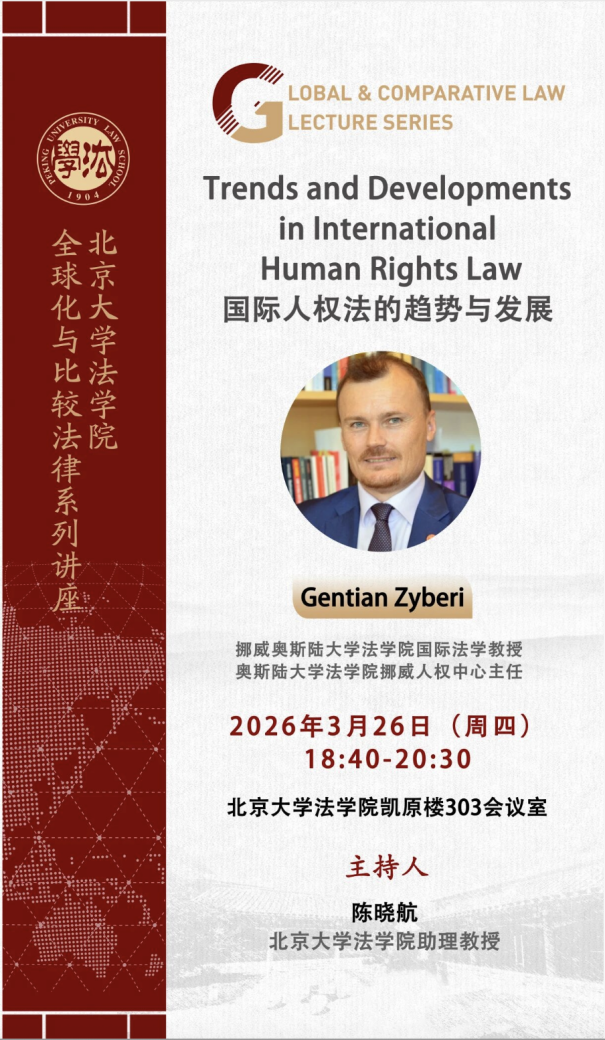
On March 26, 2026, delivered by Gentian Zyberi, Professor of International Law and Director of the Norwegian Centre for Human Rights at the University of Oslo Faculty of Law, hosted by Professor Chen Xiaohang, Peking University Law School held a lecture “Trends and Developments in International Human Rights Law” under its Global & Comparative Law Lecture Series. The session seeks to deepen the academic communication on international human rights law and share frontier research progress in this field.
Christian Gomille, Principles of Orality and Oral Hearings in the Digital Era
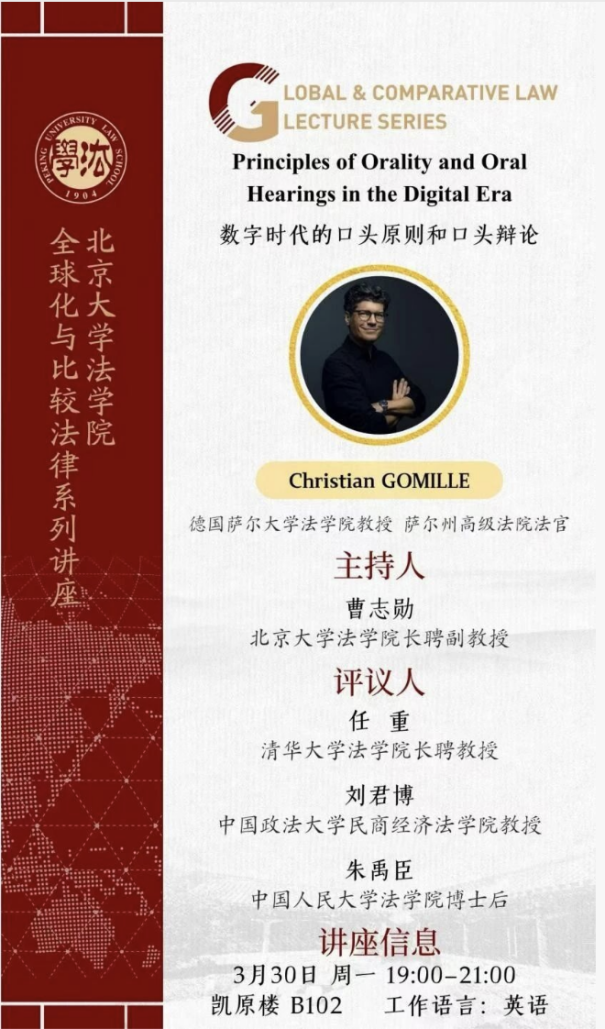
On March 30, 2026, Professor Christian Gomille of Saarland University examined the orality principle in German civil procedure under §128 ZPO and its application in arbitration. He discussed the rise of video hearings as a tool balancing efficiency and interactivity, analyzed the German framework under §128a ZPO, and addressed limitations of video proceedings, including impaired credibility assessment, cross-border jurisdictional complications, and technical risks. He also considered arbitration’s greater flexibility in adopting remote hearings. He concluded that oral hearings remain essential, but video technology offers important solutions to practical obstacles.
For more information on this lecture, please visit:
https://www.law.pku.edu.cn/xwzx/xwdt/213413fa3b0648c48e41423b6c740383.htm
Gonzalo Larrea, Corporate Sustainability Law in Europe and China. Imitation, Contestation, or Adaptation?
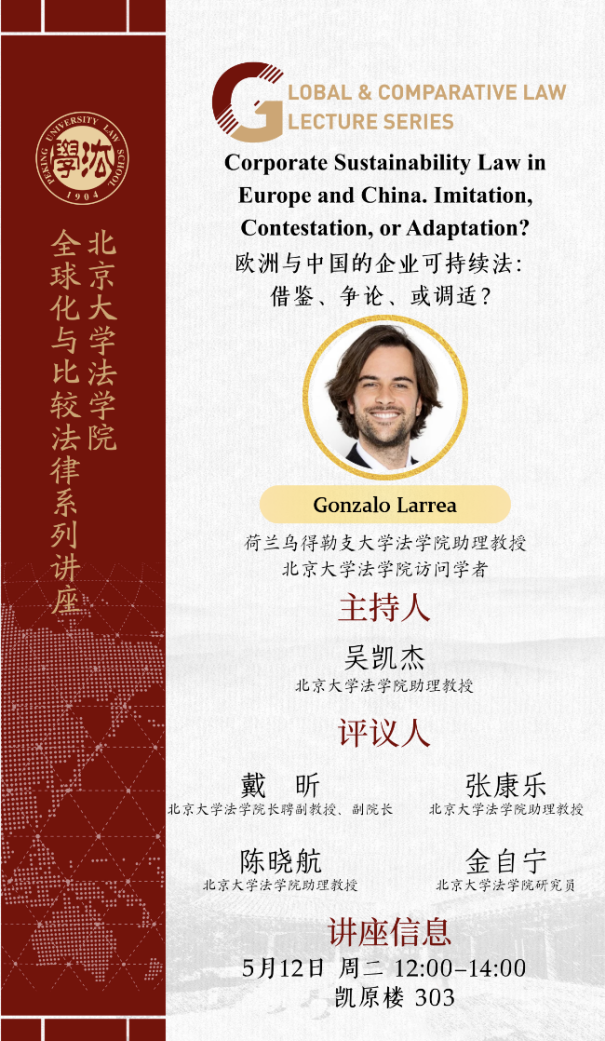
On May 12, 2026, Assistant Professor Gonzalo Larrea of Utrecht University examined the EU and Chinese corporate sustainability regulatory frameworks against a backdrop of over €845 billion in annual EU-China trade. He analyzed the EU’s post-2019 Green Deal architecture covering supply chain due diligence and sustainability disclosures, finding strategic adaptation by China alongside significant contestation — including restrictions on foreign due diligence data collection and countermeasures against extraterritorial rules. He warned that regulatory fragmentation creates dual compliance burdens, legal uncertainty, and risks to supply chain sustainability transparency.
For more information on this lecture, please visit:
https://www.law.pku.edu.cn/xwzx/xwdt/d5773f00b3da43419253b3837ef81378.htm
Catherine Malecki, The Future of Sustainable Corporate Governance: Is the Answer Blowing in the European or the French Wind
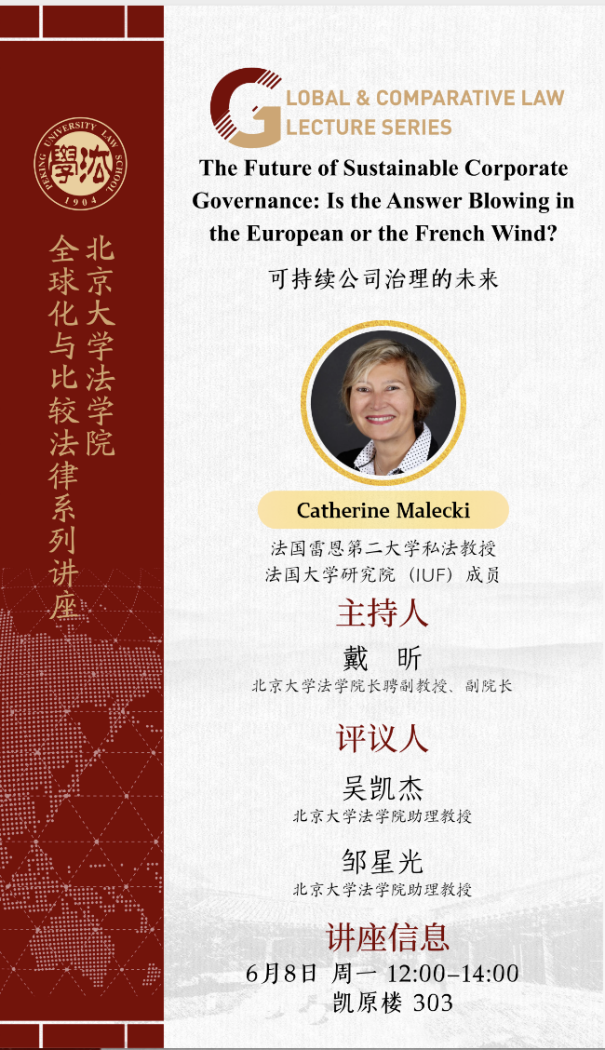
On June 8, 2026, Professor Catherine Malecki of the University of Rennes 2 delivered a lecture at Peking University Law School on the evolving framework of sustainable corporate governance. She traced the EU’s regulatory arc from the European Green Deal and CSRD/CSDDD to the 2026 Omnibus Package, which cut mandatory sustainability reporting obligations by approximately 80%, producing a “two-speed” governance landscape. She highlighted France’s pioneering role through the Loi Vigilance and Loi Pacte, the emergence of sustainable directors’duties, and the distinctive EU concept of double materiality. The discussion addressed China’s 2023 Company Law reforms and the tension between private and public law tools in enforcing environmental compliance.
For more information on this lecture, please visit:
https://www.law.pku.edu.cn/xwzx/xwdt/1acf43fdc78d4ac3adc3cf966245535c.htm
Joel Slawotsky, Corporations and National Security: Implications for Corporate Governance
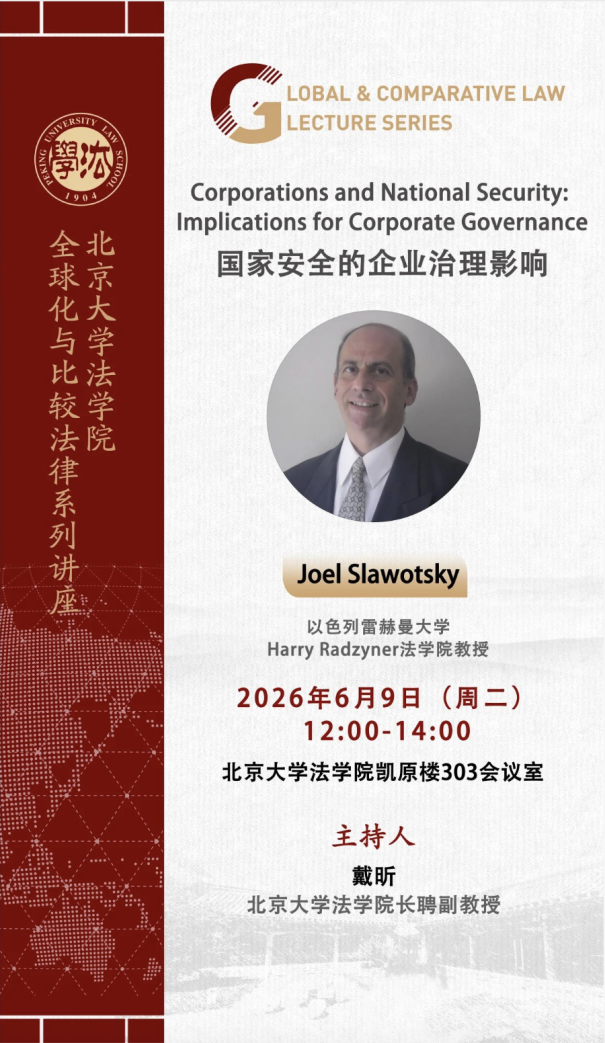
On June 9, 2026, PKU Law School and the PKU Center for Rule of Law Studies hosted a lecture by Professor Joel Slawotsky of Reichman University, moderated by Associate Dean Dai Xin with Assistant Professor Zhang Kangle as discussant. Slawotsky argued that geopolitical competition now spans economic, technological, and ideological dimensions, and that large corporations, from AI and semiconductors to social media, have become de facto national security assets. He documented how the U.S. is systematically injecting national security considerations into corporate governance, citing examples such as converting CHIPS Act grants into government equity in Intel, acquiring a “golden share” in U.S. Steel, and restricting dividends for major defense contractors. Discussants noted that state-market entanglement is not new and that the difference between Chinese and American models is one of degree rather than kind, drawing historical parallels to the East India Company.
For more information on this lecture, please visit:
https://www.law.pku.edu.cn/xwzx/xwdt/5f9902bdcc7742e3862a7249688a2697.htm
Alla Pozdnakova, A Changing Arctic and International Law
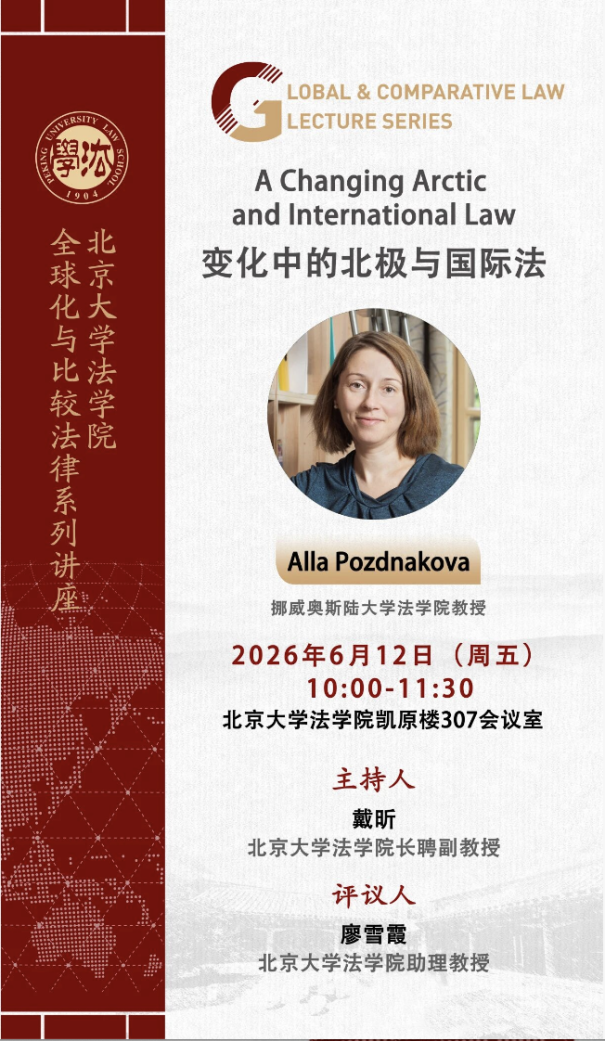
On June 12, 2026, Professor Alla Pozdnakova of the University of Oslo Faculty of Law delivered a lecture at PKU Law School as part of the “Globalization and Comparative Law” series, moderated by Associate Dean Dai Xin with Assistant Professor Liao Xuexia as discussant. Pozdnakova outlined how Arctic warming — proceeding at three times the global average — is reshaping the region’s geopolitical and legal landscape, opening new shipping routes while generating governance challenges such as “shadow fleets,” falsified vessel registrations, and inadequate environmental compliance. She surveyed the existing legal framework, including UNCLOS Article 234, the IMO Polar Code, and the newly effective BBNJ Agreement, and called for a shift from jurisdiction-based toward ecosystem-based ocean governance. Discussants raised questions about U.S. extended continental shelf policies, the difficulty of reforming Cold War-era maritime law in today’s political climate, and whether Arctic governance will remain regional or trend toward a more global model involving non-Arctic states like China.
For more information on this lecture, please visit:
https://www.law.pku.edu.cn/xwzx/xwdt/303971f3aec04c01a3da4a271c1dd4c7.htm
Qiao Shitong, Order Without Law?
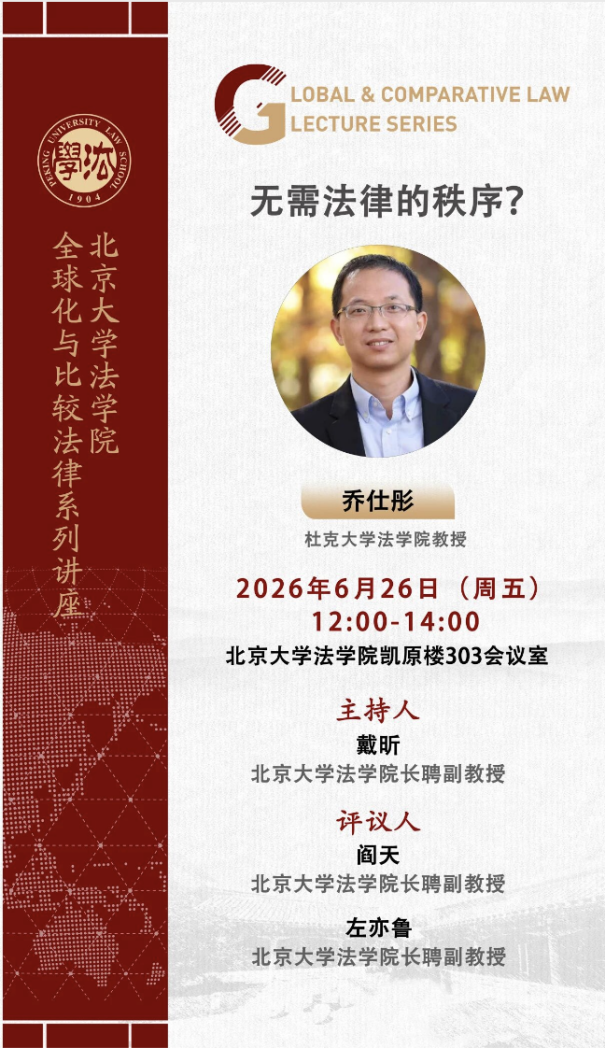
On June 26, 2026, PKU Law School hosted a lecture by Professor Qiao Shitong from Duke University introducing his “Social Norms 2.0” analytical framework, which reframes the study of order beyond law through the lens of co-evolution among social norms, legal institutions, and political authority. Building on foundational works by Ellickson, Ostrom, and Bernstein, Qiao drew on over a decade of China fieldwork across three case studies: Shenzhen’s small-property-rights housing market, where large-scale informal real estate transactions thrive without formal legal enforcement; China’s VIE corporate structures, where trillion-dollar capital markets operate on political commitment and elite networks rather than contract law; and homeowners’ association governance in Beijing, Shanghai, and Shenzhen, where Shanghai courts creatively upheld community bylaws to enable effective self-governance. Qiao argues that order emerges from the dynamic interplay of all three forces, with actors strategically navigating institutional gaps.
For more information on this lecture, please visit:
https://www.law.pku.edu.cn/xwzx/xwdt/86aa41815d724e1bb0d820ffe23678ed.htm