



【Lecture Notice】 Ntina Tzouvala : Rethinking Dollar Hegemony—An Analysis from the Perspectives of International Law and Political Economy
Date:2026-11-16
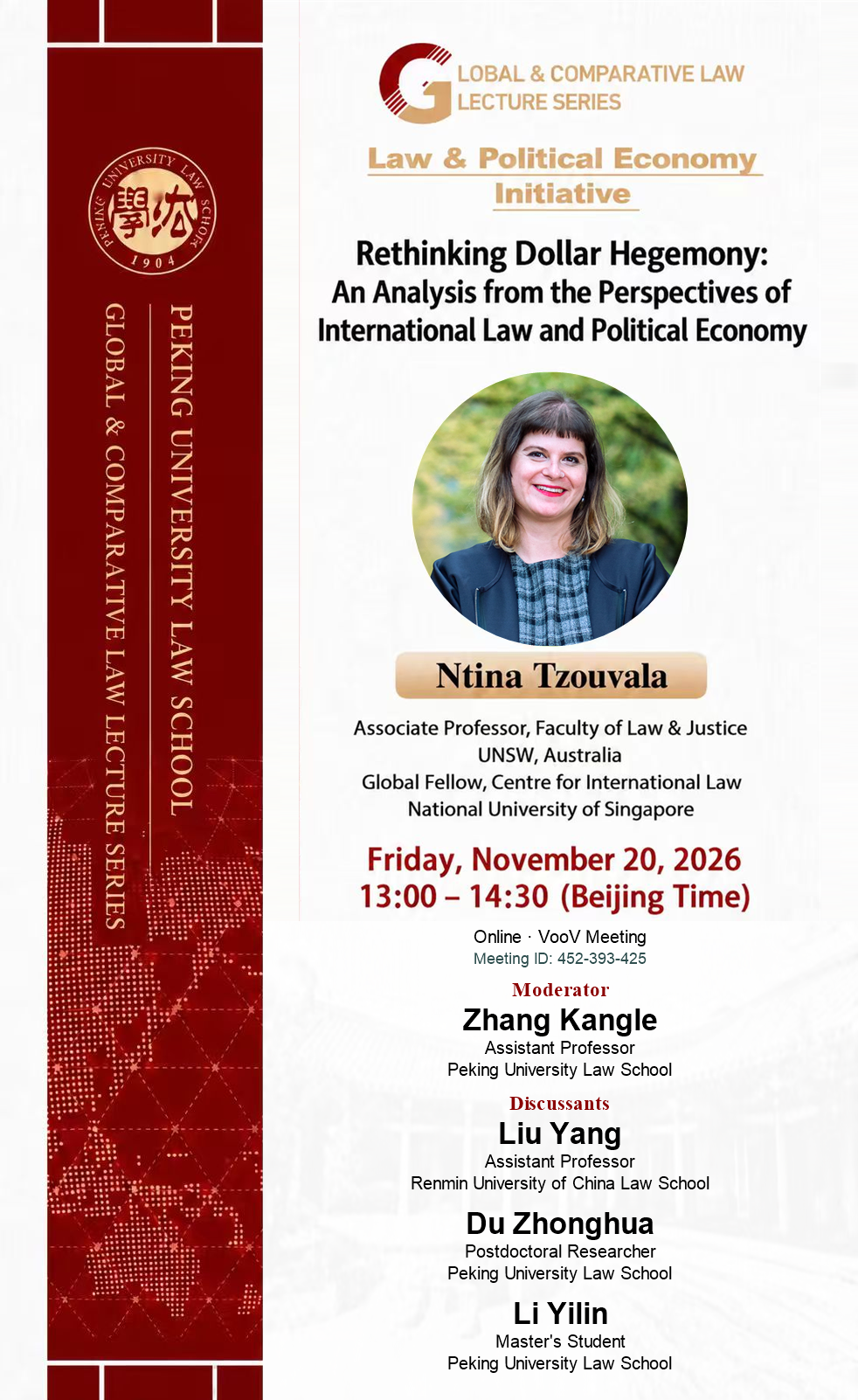
Topic: Rethinking Dollar Hegemony—An Analysis from the Perspectives of International Law and Political Economy
Time: November 20, 2026 (Friday) 13:00–14:30 (Beijing Time)
Venue: VooV Meeting ID 452-393-425
Speaker: Ntina Tzouvala
Moderator: Zhang Kangle, Peking University Law School, Assistant Professor
Discussants: Liu Yang, Renmin University of China Law School, Assistant Professor
Du Zhonghua, Peking University Law School, Postdoctoral Researcher
Li Yilin, Peking University Law School, Master's Student
About the Speaker:
Ntina Tzouvala is a prominent scholar of public international law. She is an Associate Professor in the Faculty of Law & Justice at UNSW, Australia, and a Global Fellow at the Centre for International Law, National University of Singapore. She joined UNSW in January 2025, having previously served as an Associate Professor and Associate Dean at the Australian National University (ANU) College of Law. Her research focuses on the history, theory and political economy of international law, with particular interests in historical materialism, deconstruction, and feminist and queer legal theory. Her work is situated within Third World Approaches to International Law (TWAIL) and critical international legal scholarship.
Her first monograph, Capitalism as Civilisation: A History of International Law (Cambridge University Press, 2020), is a significant contribution to the historiography of international law. Combining Marxist and deconstructive approaches, it recasts “civilisation” as a pattern of argument concerning the distribution of rights and obligations among different communities. It traces the oscillation between the “logic of improvement” and the “logic of biology”, revealing how international law accommodates and seeks to mediate the contradictions of capitalism as a global system of production and exchange. The book received the 2022 American Society of International Law (ASIL) Certificate of Merit and the Australian Legal Research Award (ALRA) in the book category, and was shortlisted for the Deutscher Prize.
Lecture Abstract:
This lecture explores what monetary hierarchies can tell us about the interplay between international law and political economy. It begins by tracing the transition from “dollar hegemony” to “dollar dominance” and the accompanying changes in the legal forms underpinning US monetary power. In the era of neoliberal dollar hegemony, soft law and ad hoc coordination between legal and economic authorities played a crucial role, giving legal or quasi-legal expression to an institutional arrangement in which persuasion outweighed coercion. By contrast, “dollar dominance” denotes an arrangement in which the balance between coercion and persuasion is reversed, with unilateral executive action and even extra-legal threats taking centre stage. Drawing on this case, the lecture examines the historically specific role of law in constituting political-economic relations and critically reflects on the increasingly influential position of “strong legal institutionalism” within the Law and Political Economy (LPE) movement.